

Quality Mold

2026 Best 360 Degree Swivel Stand for Global Buyers?

Choosing the right 360 degree swivel stand in 2026 requires more than comparing prices or polished product photos. Global buyers need a clear view of load capacity, rotation range, base stability, material quality, and device compatibility. A stand that feels solid on a showroom table may wobble on a narrow desk. Small details matter.

This guide examines practical features that affect daily use, including smooth swivel movement, locking positions, cable clearance, protective padding, and installation requirements. It also considers international purchasing concerns, such as metric measurements, packaging strength, warranty support, replacement parts, and regional compliance information. These factors can influence the real cost after shipping. They can also affect safety and user confidence.

No stand is perfect. A higher weight rating does not always mean better stability. Likewise, a full 360-degree rotation may be unnecessary for a fixed workspace. Buyers should match the stand with the device’s size, center of gravity, mounting pattern, and operating environment. In hands-on comparisons, repeated rotation tests and careful inspection of joints often reveal weaknesses that product descriptions overlook. A spec sheet can still mislead.

The following overview is designed for importers, retailers, office planners, and individual customers worldwide. It focuses on verifiable specifications and realistic use cases rather than exaggerated claims. Product availability may change during 2026, and regional support can vary. Check current technical documents before ordering.
2026 Best 360 Degree Swivel Stand for Global Buyers?

What Is a 360-Degree Swivel Stand? Key Types, Uses, and 2026 Buyers’ Needs

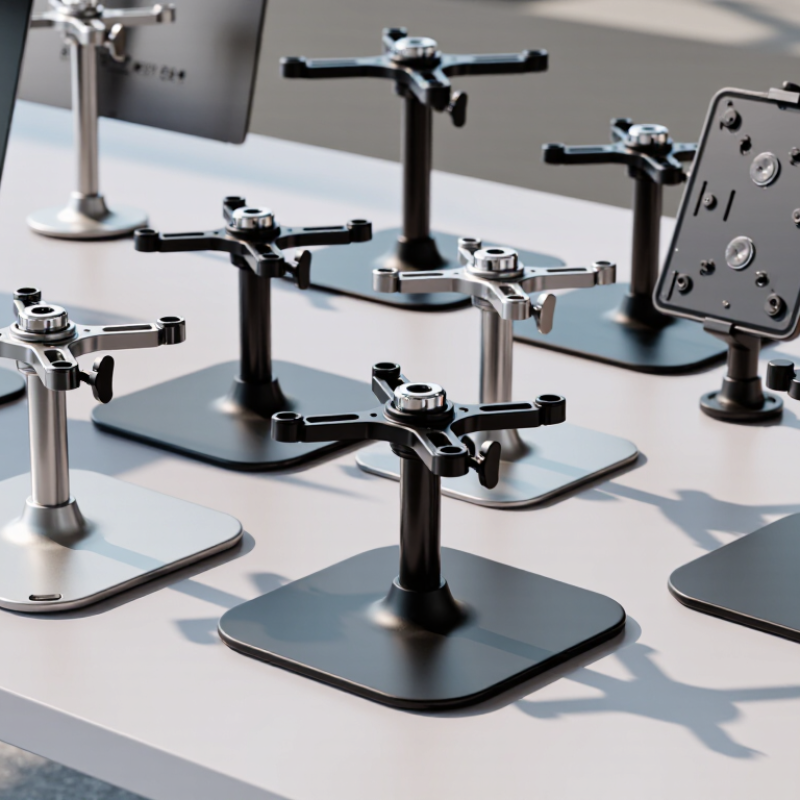
A 360-degree swivel stand is a platform or mounting frame that rotates horizontally around a central axis. It lets users turn a monitor, display, tablet, camera, or small device without lifting it. Common types include bearing-based lazy-Susan platforms, VESA monitor mounts, floor stands, countertop display bases, and enclosed kiosk supports. Each type serves a different load and space requirement.

The use case matters. A retail display may need smooth rotation and hidden wiring, while a medical monitor requires controlled movement and easy cleaning. A workshop stand needs a stronger bearing, wider base, and resistance to vibration. Grand View Research reported continued growth in the global ergonomic office furniture market through 2030, reflecting stronger demand for adjustable workstations. Buyers are therefore examining viewing angles, posture, and desk-space efficiency, not only appearance. Small details matter.

For 2026 purchasing, verify maximum load, mounting-hole standards, rotation resistance, anti-tip performance, and cable clearance. TÜV and similar testing organizations emphasize product safety, stability, and durability through structured evaluation, although requirements vary by market. A 2024 report from the International Data Corporation projected sustained growth in monitor shipments for commercial and home work environments, supporting demand for flexible display hardware. Yet forecast figures differ by methodology. Do not treat them as guarantees. In practical inspections, a stand that turns too freely can feel cheap, while excessive friction frustrates daily use. Powder-coated steel, sealed bearings, replaceable fasteners, and recyclable packaging are increasingly sensible choices. But “eco-friendly” claims still need evidence.

How 360° Rotation, Load Capacity, and VESA Standards Define Stand Performance

2026 Best 360 Degree Swivel Stand for Global Buyers?

A 360° swivel stand should turn smoothly without shifting its center of gravity. In real use, a stiff hinge quickly becomes frustrating during screen sharing or collaborative work. Test the rotation with the intended display attached, not with an empty stand. A full circle sounds impressive. Control matters more.

Load capacity must match the complete setup, including the monitor, adapter, cable tension, and any mounting plate. A stand rated for 20 kilograms may feel unstable when its arm extends outward. I once underestimated cable resistance, and the display slowly pulled sideways. That small detail changed my view of “maximum load.” Choose a safety margin of at least 20 percent, where practical.

VESA standards define whether the display and stand can connect correctly. Common patterns include 75 × 75 mm and 100 × 100 mm, but hole spacing alone does not confirm compatibility. Check screw size, thread depth, plate shape, and the display’s rear clearance. A VESA label can still hide installation problems. Use the supplied hardware only when its length suits the mounting holes. Overlong screws may damage internal components, while short screws can loosen under movement. Inspect the joint after installation, then rotate the screen slowly through its full range. Some stands promise effortless adjustment, but real performance depends on balance, tightening accuracy, and daily handling.

2026 Best 360 Degree Swivel Stand for Global Buyers?

How 360° rotation, load capacity, and VESA standards define stand performance.

The chart shows common VESA mounting patterns using accurate center-to-center hole spacing in millimeters. VESA dimensions define display compatibility, while load capacity depends on the stand’s mechanical design and must be checked separately. A 360° swivel describes the rotation range of the stand and should be evaluated together with its rated load and locking stability.

Comparing Steel, Aluminum, and ABS: Strength Data and Weight Trade-Offs

For a 360-degree swivel stand, material choice changes both handling and long-term stability. ASM International’s ASM Handbook lists steel density near 7.85 g/cm³, aluminum near 2.70 g/cm³, and ABS near 1.04 g/cm³. Steel therefore provides the highest mass and often the strongest resistance to tipping. Typical low-carbon steel can reach about 250–370 MPa yield strength, depending on grade and processing. Aluminum alloys usually offer lower density but still reach roughly 240–310 MPa in common structural conditions. That is a useful weight saving. It is not a free strength upgrade.

ABS is much lighter and easier to mold around curved housings. ASTM D638 data commonly places its tensile strength near 35–50 MPa. Its practical weakness appears under heat, repeated loading, and concentrated screw pressure. Creep may slowly loosen a rotating joint. I have seen a light plastic stand feel stable at first, then develop play after repeated turning. That observation needs proper laboratory confirmation, not confidence alone. ASTM D638 tensile testing and ASTM D790 flexural testing can expose weaknesses before export. For global buyers, steel suits heavy equipment and rough handling, aluminum suits portable stands, while ABS fits lighter loads and complex shapes. A hybrid design may perform better, but it complicates recycling and quality control. Weight data from the U.S. Department of Energy’s lightweight-materials research supports aluminum’s density advantage, yet real performance still depends on wall thickness, fasteners, bearing size, and load-cycle testing.

Global Safety Requirements: ISO 12100, RoHS, REACH, and Stability Testing

A 360-degree swivel stand should rotate smoothly without shifting across the desk. Global buyers should examine safety evidence before comparing finishes, colors, or advertised load ratings. ISO 12100 provides a useful framework for identifying mechanical risks, pinch points, sharp edges, and unexpected movement. It does not replace product-specific testing or local compliance checks.

A practical assessment begins with the heaviest supported device and its highest center of gravity. Test the stand on glass, wood, and slightly uneven surfaces. Measure movement during rotation, braking, and repeated loading. Stability testing should include side pressure, off-center placement, and accidental knocks. A stand may feel solid during a short demonstration, yet loosen after hundreds of cycles. That detail is easy to miss.

For electrical or coated components, request clear RoHS evidence and REACH-related substance information. Documentation should identify the tested materials, report dates, and responsible laboratory. Requirements can differ by destination, product type, and intended use. Treat vague declarations carefully. They sound convenient, but they may not support customs or market surveillance questions. I have found that simple records are often more reliable than polished claims. Still, testing can contain gaps. Reviewers should question sample selection, load limits, and whether production units match the tested model. A small inspection log, torque check, and dated stability video can improve traceability for buyers and suppliers.

2026 Buyer Scorecard: Price, Warranty, MOQ, Certifications, and Total Cost of Ownership

For global buyers, a 2026 swivel-stand scorecard should begin with landed cost, not catalogue price. Record the unit quotation, tooling, packaging, freight, duties, installation, and expected replacement parts. An illustrative order of 500 units at $18 each, plus $1,200 freight, already reaches $20.40 per unit before taxes. MOQ matters. Excess inventory can quietly become a financing cost.

Warranty terms need practical detail. Check coverage length, swivel-cycle limits, exclusions, response time, and who pays return freight. Small hinges matter. A 24-month warranty with no replacement-stock commitment may offer less protection than a shorter, clearly administered warranty. My first scorecard mistake was treating warranty duration as quality evidence. It is only a promise until the supplier explains the process.

Certifications should be verified by certificate number, scope, expiry date, and accredited testing body. The ISO Survey 2023 reported 1,265,216 ISO 9001 certificates worldwide, showing that certification is common, but not automatically product-specific. Ask for material declarations, load-test results, corrosion testing, and safety documentation relevant to the destination market. Calculate total cost of ownership over three years: purchase, logistics, labor, failures, returns, and disposal. The European Commission’s Product Environmental Footprint method also supports broader lifecycle thinking. Use it carefully; transport assumptions can distort comparisons. A cheaper stand may still lose after one cracked base or delayed replacement shipment.

2026 Best 360 Degree Swivel Stand for Global Buyers?

2026 Buyer Scorecard: Price, Warranty, MOQ, Certifications, and Total Cost of Ownership

Anonymous Offer Profile Recommended Use Load Rating 360° Rotation EXW Price
(USD/unit)
Typical MOQ Warranty & After-Sales Terms Certification / Compliance Documentation Estimated Landed Cost
(USD/unit)
3-Year TCO
(USD/unit)
Buyer Score
(100 points)
Value ABS Desktop Stand
Injection-molded ABS body with steel swivel plate
Retail counters, tablets, lightweight displays and kiosks Up to 5 kg Full 360° rotation
Manual friction lock
$8.50–$12.00 100 units 12 months
Defective-unit replacement normally limited to verified manufacturing defects
RoHS and REACH declarations commonly available.
Request material test reports and screw-plating documentation.
$12.50–$18.50 $14.50–$21.00 78
Best price
Aluminum Office Stand
Die-cast aluminum base with silicone anti-slip pad
Offices, meeting rooms, reception desks and premium retail Up to 8 kg Full 360° rotation
Adjustable resistance
$15.00–$22.00 50 units 24 months
Spare pads and fasteners generally available; confirm replacement lead time
RoHS, REACH and aluminum-alloy material declaration typically available.
CE is not normally required for a passive stand unless sold with powered electronics.
$20.50–$30.00 $23.00–$33.50 89
Best overall
Heavy-Duty Steel Stand
Powder-coated steel base and reinforced bearing assembly
Commercial displays, POS equipment and high-use environments Up to 15 kg Full 360° rotation
Lockable at selected angles
$24.00–$36.00 30 units 24 months
Better suited to service contracts; confirm bearing-cycle test results
RoHS and REACH documentation commonly available.
Ask for coating, salt-spray and load-cycle test reports.
$32.00–$47.00 $34.00–$51.00 87
Best durability
Retail Security-Ready Stand
Aluminum or steel body with concealed mounting hardware
Retail stores, exhibitions and public-facing installations Up to 10 kg Full 360° rotation
Optional angle limiter
$28.00–$45.00 100 units 24 months
Custom keyed fasteners may increase spare-part and service costs
RoHS and REACH declarations generally available.
Request tamper-resistance test evidence and hardware specification.
$37.00–$58.00 $40.00–$63.00 84
Best for retail
Custom-Brand OEM Stand
Custom color, logo, packaging and mounting interface
Multi-country retail programs and private-label distribution Up to 8–12 kg
Depending on design
Full 360° rotation
Custom stop positions available
$18.00–$32.00 500 units 18–24 months
Tooling, artwork approval and engineering-change terms must be written into the contract
RoHS, REACH and packaging declarations can usually be arranged.
Product-specific testing is required for any powered accessory.
$24.00–$42.00 $27.00–$47.00 86
Best for scale
Premium Universal Display Stand
Machined aluminum, hardened steel bearing and modular adapters
Premium offices, hospitality, studios and frequent reconfiguration Up to 12 kg Full 360° rotation
Smooth bearing movement with tension adjustment
$38.00–$65.00 20 units 36 months
Usually offers the strongest parts availability and lowest expected failure rate
RoHS and REACH documentation commonly available.
Request alloy certificates, bearing test data and packaging drop-test results.
$49.00–$82.00 $50.00–$84.00 91
Best long-term value
Methodology and buyer notes: Prices are indicative 2026 market ranges for passive 360-degree desktop swivel stands and are shown without company or brand identification. Estimated landed cost assumes a 100-unit order, standard export packaging, consolidated international freight, import clearance and ordinary duties; actual costs vary by destination, trade term, shipping mode and local tax. Three-year TCO includes estimated purchase, freight, one expected spare-parts allowance and routine replacement costs, but excludes VAT/GST, installation labor and financing. RoHS and REACH are product-material compliance documents; CE, FCC and similar marks should only be requested when the stand includes electrical or electronic components. Before purchase, verify load testing, rotation-cycle results, corrosion resistance, packaging performance, warranty exclusions, spare-part availability and destination-country import requirements.