

Quality Mold

2026 Top Metal Scaffolding Planks for Global Buyers

Global buyers entering the 2026 scaffolding market need more than attractive product photos and low quotations. Metal Scaffolding Planks support workers, materials, and daily movement at elevated levels. Their quality directly affects site efficiency and safety. In practical purchasing, small details matter. A plank’s length, width, thickness, surface pattern, and edge design can change its performance on a busy construction site.

This guide examines leading metal scaffolding planks for international buyers, including steel and aluminum options. It considers load capacity, slip resistance, corrosion protection, drainage holes, weight, and compatibility with common scaffold systems. Buyers should also review welding quality, dimensional tolerance, inspection reports, and packaging methods. A reliable supplier should provide clear technical data, traceable testing, and consistent production records. Safety comes first.

However, no single plank suits every project or climate. A lightweight aluminum plank may reduce manual handling, while galvanized steel can offer greater rigidity under demanding conditions. Coastal projects may require stronger corrosion protection than dry indoor work. Local regulations and project specifications must always be checked independently. A polished catalog is not proof of performance. Samples, factory audits, and third-party verification can reveal weaknesses that brochures hide.

This overview is designed to help distributors, contractors, and procurement teams compare products more carefully. It also recognizes an uncomfortable truth: price comparisons are often incomplete. Freight, replacement rates, storage damage, and worker handling costs can change the final value. The best choice is not always the cheapest plank. It is the one that performs reliably, fits the system, and remains supportable throughout its service life.
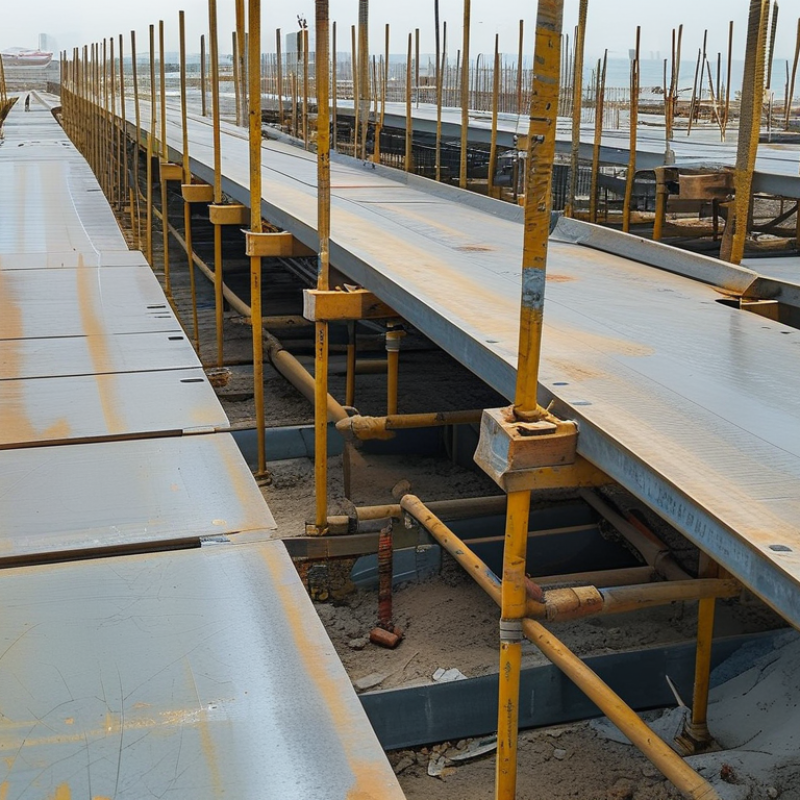
2026 Top Metal Scaffolding Planks for Global Buyers

Metal Scaffolding Plank Types: Steel, Aluminum, and Galvanized Options

Steel, Aluminum, and Galvanized Scaffolding Planks for Global Buyers

Steel scaffolding planks suit heavy-duty work and repeated industrial use. They provide strong load capacity, firm footing, and good resistance to jobsite impact. A typical steel plank feels rigid underfoot, even when workers carry buckets, tools, or compact equipment. However, steel is heavy. Transport crews may need more workers or lifting support during installation.

Aluminum planks offer a lighter alternative for maintenance, construction, and frequent repositioning. Their lower weight can reduce handling fatigue and speed up assembly. They also resist ordinary atmospheric corrosion. Yet aluminum may flex more than steel under similar loads. Buyers should check the working load, span length, surface profile, and locking details instead of judging quality by weight alone. I once favored the lightest option for easier handling, but that choice was not ideal for a long-span platform.

Galvanized steel planks combine steel strength with a protective zinc coating. The coating helps slow rust in humid, coastal, and outdoor environments. Inspectors should examine cut edges, weld areas, holes, and scratched surfaces because coating damage can expose bare steel. Drainage holes and raised anti-slip patterns also matter after rain. Before ordering, compare verified test data, dimensional tolerances, and inspection records. A qualified engineer should confirm the platform design, site conditions, and local safety requirements. Even a well-made plank cannot correct poor support, overloading, or careless installation.

Load Ratings Explained: EN 12811-1 Classes from 0.75 to 6.00 kN/m²

For global buyers, EN 12811-1:2003 defines six scaffold service-load classes. Class 1 supports 0.75 kN/m², while Class 6 reaches 6.00 kN/m². The intermediate ratings are 1.50, 2.00, 3.00, and 4.50 kN/m². These figures describe the intended working load for a scaffold platform, not an automatic capacity guarantee for every metal plank. Check the full system.

The practical difference is visible on site. A Class 3 platform may carry workers, hand tools, and limited materials at 2.00 kN/m². Heavy masonry storage needs a higher class and verified design. EN 12811-1 also requires attention to span, deflection, access, and platform stability. HSE guidance HSG150 links safe scaffolding to design, inspection, and controlled loading. That distinction matters.

Buyers should request test evidence, dimensional tolerances, anti-slip details, corrosion protection, and stated point-load limits. A plank rated for uniform loading may perform poorly under one concentrated pallet load. Do not guess. My own review experience suggests that catalog tables often simplify site conditions too much. Weather, damaged edges, uneven supports, and repeated handling can reduce real performance. The rating is a starting point, not permission to overload.

EN 12811-1 load classes define the uniformly distributed imposed load for scaffold working platforms. The values range from 0.75 to 6.00 kN/m², equivalent to approximately 76 to 612 kg/m². Actual selection should consider the intended work, materials, equipment, and the complete scaffold design.

Safety Standards for Global Buyers: EN 12811-1, OSHA, and AS/NZS 1576

2026 Top Metal Scaffolding Planks for Global Buyers

For global buyers, metal scaffolding planks should be selected against the project’s governing standard, not appearance. EN 12811-1 evaluates scaffold performance, including strength, serviceability, and stability under defined loads. It also requires practical consideration of deflection and working-platform conditions. A plank that feels rigid may still fail a calculated load assessment.

OSHA rules under 29 CFR 1926 Subpart L require scaffold components to support their intended loads and protect workers from falls. The U.S. Bureau of Labor Statistics recorded 1,069 construction fatalities in 2022; 395 involved falls, slips, or trips. OSHA identifies falls as the leading construction fatality cause. Small details matter. Check plank hooks, end stops, welds, locking points, and surface damage before every shift.

AS/NZS 1576 provides requirements for scaffold equipment used in Australia and New Zealand, including structural performance and safe use. Buyers should request test evidence, material specifications, and traceable inspection records. Coating quality also matters near coastal sites, where corrosion can reduce effective thickness. A certificate is not a substitute for inspection. That is easy to forget.

Site teams should verify span, load class, platform width, and compatibility with the complete scaffold system. Mixed components create uncertainty. In practice, standards may be interpreted differently by engineers, inspectors, and contractors. Recheck assumptions before ordering large volumes. A stronger-looking plank is not automatically a safer plank.

2026 Top Metal Scaffolding Planks for Global Buyers - Safety Standards for Global Buyers: EN 12811-1, OSHA, and AS/NZS 1576

Evaluation Dimension EN 12811-1:2003 OSHA 29 CFR 1926.451 AS/NZS 1576 Series Global Buyer Checklist
Primary application Performance requirements and general design for temporary works equipment, including access and working scaffolds. Minimum requirements for scaffolds and scaffold platforms used in workplaces in the United States. Requirements for access and working scaffolding, including general design, construction, and component requirements. Confirm the standard required at the installation site before purchasing.
Load classification Service load classes range from 0.75 to 6.00 kN/m², depending on the intended scaffold use and design. The scaffold must support its own weight plus at least four times the maximum intended load, without failure. Load capacity is determined by the applicable scaffold configuration, component design, and specified working loads. Request load tables, test reports, and span limits for the exact plank model.
Typical metal plank materials Common options include galvanized steel or aluminium; the selected material must satisfy the structural design. Metal components must be suitable for the intended loads and conditions; damaged or weakened components must not be used. Steel and aluminium components may be used when they meet the applicable structural and safety requirements. Check alloy or steel grade, corrosion protection, weld quality, and compatibility with the scaffold system.
Common product width range Product width is selected according to the scaffold system and required platform width; it is not a single universal plank size. A scaffold platform and walkway is generally required to be at least 18 in wide, approximately 460 mm, unless a permitted exception applies. Width depends on the scaffold design, access arrangement, and applicable component requirements. Select a width that creates a compliant platform after allowing for gaps, braces, access, and edge protection.
Typical product length range Length is determined by bay spacing and the manufacturer’s tested structural configuration. Planks must be properly supported and secured; overhang requirements apply unless the platform is specifically designed otherwise. Length must match the engineered bay dimension and the approved scaffold system. Verify clear span, support position, allowable overhang, and transport dimensions.
Platform surface The working surface should be suitable for the intended use and provide stable support for personnel and materials. Platforms must be fully planked or decked, except where specific regulatory exceptions apply. Surface construction must provide a stable working platform and comply with the relevant access and scaffold requirements. Prefer formed anti-slip surfaces, drainage openings, and no sharp exposed edges.
Slip resistance The surface should be selected for safe use under expected wet, dusty, or contaminated conditions. Platforms and walkways must be free of slip hazards and must not contain unsafe conditions. Surface safety must be suitable for the intended access and working conditions. Ask for wet-slip test information where planks will be used outdoors or in industrial environments.
Plank retention Planks and decks must remain stable under the specified design actions and scaffold configuration. Platforms and walkways must be secured to prevent displacement; planks must not be allowed to move or tip. Components must be connected and restrained in accordance with the applicable scaffold design. Check locking hooks, end collars, anti-lift features, and compatibility with transoms.
Guardrails and edge protection The scaffold design must provide appropriate collective protection against falls. Guardrails, midrails, and toeboards or equivalent protection are required where applicable to prevent falls and falling objects. Edge protection must follow the applicable Australian and New Zealand scaffold requirements. Confirm guardrail-post spacing, toeboard compatibility, and platform edge clearances.
Corrosion protection Corrosion and deterioration must not reduce the component’s structural performance. Components showing damage, excessive rust, bends, cracks, or other defects must be repaired or removed from service. Components must remain fit for service and maintain required structural performance in the intended environment. For outdoor use, specify hot-dip galvanizing or an equivalent corrosion-control system and inspect cut edges.
Inspection and maintenance Inspection and continued suitability should be managed under the scaffold design, site procedures, and applicable national rules. A competent person must inspect scaffolds and components before each work shift and after events that could affect structural integrity. Inspection, maintenance, and use must follow the applicable standard, site procedures, and the scaffold supplier’s instructions. Require traceable inspection records, defect criteria, repair limits, and quarantine procedures.
Recommended documentation Design calculations, load class, component identification, assembly instructions, and inspection information. Load information, competent-person inspection records, training records, and site-specific scaffold documentation. Engineering information, component specifications, assembly instructions, inspection procedures, and compliance evidence. Request material certificates, dimensional drawings, test reports, installation instructions, and a declaration of conformity where applicable.
Best selection priority for 2026 Use a tested plank-and-scaffold-system combination with a clearly stated load class. Prioritize full platform coverage, secure plank retention, competent inspection, and compliance with site fall-protection requirements. Choose components supported by approved design information for the intended scaffold configuration. Buy based on verified capacity, system compatibility, corrosion resistance, traceability, and local regulatory acceptance—not price alone.
Technical note: EN 12811-1, OSHA 29 CFR 1926.451, and the AS/NZS 1576 series do not define one universal metal plank size or one globally interchangeable product. Final selection must be based on the approved scaffold design, actual span, working load, platform width, environmental conditions, and the regulations applicable at the installation site.

2026 Buying Criteria: Strength, Slip Resistance, Weight, and Service Life

For global buyers, a metal scaffolding plank should be judged by evidence, not appearance. Ask for the verified working-load rating, test method, and maximum supported span. A strong plank controls bending and deflection under repeated foot traffic. Check edge profiles, weld quality, and end hooks for distortion. Small defects matter. On site, a plank may carry tools, wet boots, and unevenly placed loads. The stated rating is not permission to exceed the scaffold system’s limits. Confirm compatibility with the complete structure and local requirements.

Slip resistance deserves a practical check. Textured surfaces can improve grip, but mud, paint, ice, and metal dust reduce performance. Request wet-condition test data when work occurs outdoors. Drain holes should remove water without creating sharp edges or weak zones. Walk the sample with ordinary safety footwear. It should feel stable, not aggressively abrasive. That judgment is partly subjective. A supplier should explain the test standard, inspection frequency, and replacement threshold in clear language.

Weight affects labor, transport, and daily setup. Compare plank mass with its length, load capacity, and handling points. A lighter design is not automatically better; thin sections may deform sooner. Look for corrosion protection suited to humidity, salt air, and chemical exposure. Galvanized finishes can extend service life, but damaged coatings need prompt inspection. Keep records of dents, cracks, rust, and repairs. Service-life estimates remain uncertain without real usage data. Ask for warranty terms, traceable production records, and responsive technical support. That is where reliability becomes visible.

Global Supplier Comparison: Certification, Dimensions, Coatings, and Warranty

Global buyers should compare metal scaffolding planks through documented performance, not catalogue appearance. EN 12811-1 defines six working-load classes, from 0.75 to 6.00 kN/m². Ask suppliers to identify the tested class clearly. A valid certificate should match the exact plank design, dimensions, and production site. CE marking alone may not prove load capacity.

Dimensions affect both safety and handling. Common planks range from 210 to 450 millimetres wide, with lengths near 1 to 3 metres. Check hook spacing, anti-slip perforations, edge reinforcement, and deflection results. A plank may fit one frame but fail another system’s bearing requirements. The International Labour Organization stresses competent inspection and safe access in construction guidance. That practical point is often missed during purchasing.

Tips: Request a sample, coating report, test certificate, and written warranty before ordering. For outdoor projects, compare hot-dip galvanizing with painted steel. ISO 12944 links coating selection to corrosive exposure, while ASTM A123 and A153 provide widely used galvanizing references. Confirm coating thickness in microns, not simply “galvanized.” Warranty terms should state load-related defects, rust limits, inspection duties, and claim procedures. Some suppliers offer five years, but duration means little without exclusions. I would also verify batch traceability; paperwork can look complete, yet the delivered plank may differ slightly. That is an uncomfortable detail, but it matters.