

Quality Mold

7 Best Box Manufacturing Machines for Global Buyers

Choosing a Box Manufacturing Machine is not simply a matter of buying the fastest equipment. A converting line must match the box styles, board grades, order volumes, and labor skills a plant actually has. A small operation may value quick changeovers and a modest footprint. A high-volume facility may need reliable feeding, precise printing, slotting, folding, and gluing at sustained speed. Details matter: a feeder that slips on warped sheets can disrupt an otherwise capable line.

This introduction uses a clearly fictional composite expert, packaging engineer Elena Morris, to express a practical buying principle: “A machine proves its value when it keeps box quality consistent through real production changes.” The quotation is illustrative, not a sourced statement from a real expert. Buyers should verify supplier claims with machine demonstrations, sample runs, and service references. Look closely at setup time, waste rates, operator training, spare-parts access, and the space required for installation. Impressive maximum speed is not the whole story.

The seven machines in this guide represent different production needs, from flexible setups to automated, higher-output lines. Compare each model against your own materials and daily job mix. Ask vendors to run your board, not just their showroom stock. Small differences can matter. A machine may look ideal on paper, yet prove awkward to maintain or change over. That deserves a second look.
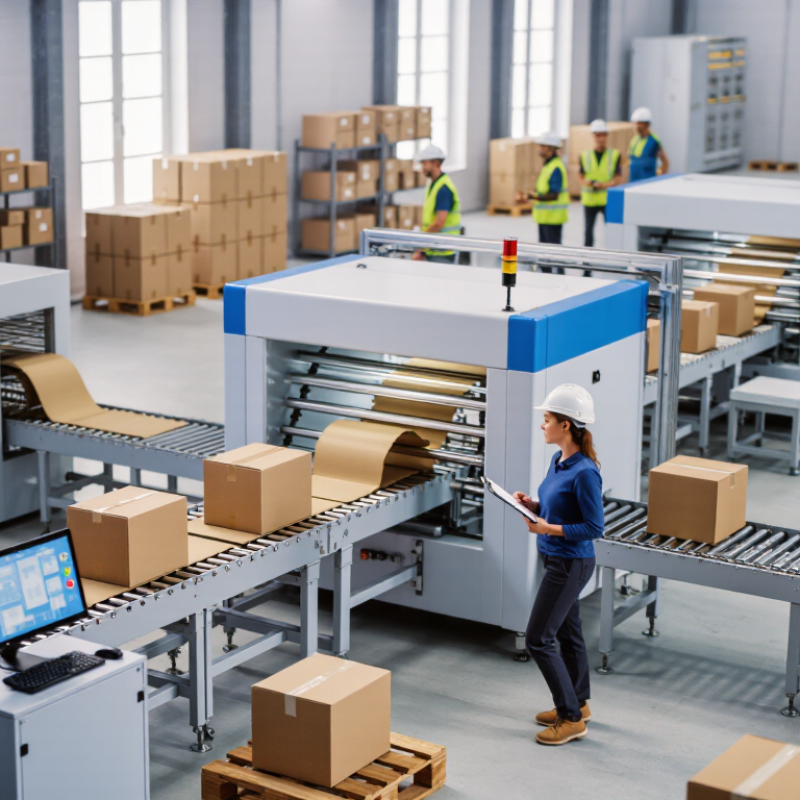
7 Best Box Manufacturing Machines for Global Buyers

How Box Manufacturing Machines Convert Materials into Finished Boxes

7 Best Box Manufacturing Machines for Global Buyers

How Box Manufacturing Machines Convert Materials into Finished Boxes

Box production begins with rolls of kraft paper. A corrugator heats and flutes the medium, then bonds it between liner sheets to form rigid board. Slitters and scorers trim the board and press fold lines. Flexographic printers add graphics, while rotary die cutters shape handles, slots, or custom outlines. Small details matter.

The FEFCO European Database Report 2023 records about 48 billion square metres of corrugated board produced in Europe in 2022. That scale helps explain why accurate feeding, registration, and glue control matter: small errors can multiply across long runs. Folder-gluers or stitchers close the blanks, and bundlers prepare finished boxes for shipment. Yet automation is not magic; changeovers and unsuitable board settings can still cause waste.

Tips: Match machine capacity to your common box sizes and board grades, not just peak speed. Ask for trials using your own material, and inspect fold accuracy, print alignment, and joint strength. A setup that looks efficient on paper may struggle with frequent size changes.

Key Machine Types for Different Box Styles and Production Needs

Box styles determine the machine line. Regular slotted cartons often run on flexo folder-gluers, which print, slot, fold, and glue corrugated sheets in one pass. A rotary die cutter suits display boxes and unusual outlines, such as a carton with a built-in handle. For folding cartons, look at sheet-fed presses, die cutters, and folder-gluers instead. Corrugators make the board itself, so they fit buyers with substantial, steady volume—not every converting plant.

FEFCO’s 2023 European Database reports 49.7 billion square metres of corrugated board production in Europe in 2022. That scale shows why capacity matters, but it does not mean every buyer needs a high-speed line.

Match rated output to the expected mix of box sizes, board grades, and shift hours. Check changeover time, waste during setup, and whether operators can adjust print registration without stopping the whole line.

Small details count. A sample run with the buyer’s own board can reveal crushed flutes or weak glue joints that a brochure will not. The less glamorous point: buying extra speed may leave a costly machine waiting when orders vary.

Seven Box Manufacturing Machines for Global Buyers

Seven Box Manufacturing Machines for Global Buyers

A practical box line may combine a corrugator, flexo printer-slotter, rotary die-cutter, folder-gluer, stitching machine, case erector, and bundler. Each handles a distinct step, from forming board to preparing finished cases. Grand View Research estimated the global corrugated packaging market at USD 189.4 billion in 2022, with projected growth from 2023 to 2030. That market context matters, but it does not mean every buyer needs a high-speed line. The right configuration depends on box styles, order sizes, board grades, and available floor space.

A corrugator makes the board; its heat and pressure settings affect flute shape and bonding. A flexo printer-slotter prints graphics and cuts slots in one pass, while a rotary die-cutter handles shaped designs. Folder-gluers and stitching machines close boxes in different ways. Case erectors open flat blanks, and bundlers group finished cartons for handling. Check changeover time, spare-part availability, operator training, and power requirements before comparing output speeds. Small details matter.

The report’s market forecast is not a machine-buying forecast. Buyers should request trials using their own board and artwork, then inspect print alignment, glue lines, and cut edges. A fast machine can still be the wrong one. I would also leave room for maintenance access; cramped layouts look efficient on paper, but repairs can disrupt a shift.

How to Compare Capacity, Automation, and Material Compatibility

A box machine’s advertised speed is only a starting point. Compare its sustained output with your actual shift length, order sizes, and changeover time. FAO’s Forest Products Annual Market Review reported about 417 million tonnes of global paper and paperboard production in 2022. That scale reflects varied inputs, not one standard board. Check whether the machine handles your sheet dimensions, board grades, and flute profiles. Ask suppliers to run your own samples.

Automation can reduce repetitive feeding and improve consistency, but added sensors and controls also need maintenance. Compare manual setup time, operator requirements, jam access, and spare-part availability. A high-speed line may still fall short if small batches require frequent adjustments. Request a timed trial that records usable boxes, rejects, and stoppages—not just the machine’s top speed. I would not choose on speed alone; that is an easy figure to overvalue.

Tips: Bring sheets with different calipers and moisture conditions to the trial. Measure finished box dimensions and inspect folds, cuts, and glue lines. Record changeover time, too. Small details matter. Ask for the test settings in writing, then check whether your team can repeat them on an ordinary production day.

7 Best Box Manufacturing Machines for Global Buyers — How to Compare Capacity, Automation, and Material Compatibility
Machine Type Typical Production Capacity Automation Level Compatible Materials Best Suited For Key Buying Considerations
Corrugated Flexo Printer-Slotter-Die Cutter About 60–250 sheets per minute, depending on sheet size, print colors, and box complexity Available from semi-automatic setups to fully automatic lines with feeding, printing, slotting, and die cutting in one pass Corrugated board, commonly single-wall and double-wall grades; board thickness and flute type depend on the machine configuration Shipping cartons and printed regular slotted containers (RSCs) Check maximum sheet size, print-color configuration, registration accuracy, changeover time, and whether the machine includes automatic bundling or stacking
Flexo Folder-Gluer for Corrugated Boxes Typically about 80–300 boxes per minute; actual output varies with box style, dimensions, and gluing requirements Medium to high; automatic feeding, folding, gluing, counting, and bundling are common on production lines Printed corrugated board, including many single-wall and selected double-wall constructions, subject to machine specifications High-volume production of glued corrugated cartons Compare minimum and maximum blank sizes, folding accuracy, glue system, bundle handling, and compatibility with the upstream printer-slotter
Rotary Die Cutter for Corrugated Board Often about 80–250 sheets per minute, depending on die layout, board grade, and sheet dimensions Medium to high; automatic feeding and stacking are widely available, while tooling changes are generally required for new designs Corrugated board; suitable flute profiles and board thicknesses vary by model and tooling Die-cut trays, display packaging, irregular blanks, and cartons requiring shaped edges or handles Evaluate cutting pressure, die-change setup time, waste removal, achievable detail, and whether the machine can also print or slot
Flatbed Die-Cutting and Creasing Press Commonly around 3,000–8,000 sheets per hour for commercial sheet-fed equipment; material, format, and setup affect the rate Medium to high; automatic sheet feeding and delivery are common, with manual or automated stripping options Paperboard and folding carton stock; some machines also handle corrugated sheets within specified thickness limits Precisely cut and creased folding cartons, inserts, and specialty packaging blanks Check sheet format, cutting force, registration system, stripping capability, tooling cost, and the supported range of board thicknesses
Folding Carton Folder-Gluer Typically about 100–400 meters per minute on suitable jobs; pieces per minute depend on blank length and folding style Medium to high; automatic feeding, folding, gluing, and delivery can be combined with inspection and carton counting Printed paperboard and folding carton stock; special coatings or laminated surfaces may require compatible glue and settings Straight-line, crash-lock-bottom, and other glued folding cartons Compare carton styles supported, minimum and maximum blank dimensions, glue application control, inspection options, and job changeover time
Corrugator Production Line Many commercial lines operate at roughly 100–300 meters per minute; effective output depends on paper grades, width, and changeovers High; integrated lines can automate web control, single-facing, heating, slitting, scoring, cutting, and stacking Paper reels used to produce corrugated board, including linerboard and fluting medium; paper weights and flute profiles depend on line design Large-scale production of corrugated sheets for downstream box converting Assess working width, design speed versus sustained production speed, steam and energy needs, flute configurations, and required floor space
Rigid Box Making Machine Often about 10–40 finished boxes per minute for automated equipment; box size, wrapping style, and operator loading affect output Ranges from semi-automatic forming and wrapping equipment to automated lines with board feeding, corner pasting, and wrapping Rigid paperboard or greyboard with printed, coated, or decorative wrapping paper; material thickness and finish must suit the machine Premium setup boxes, gift boxes, electronics packaging, and other non-collapsible rigid packaging Check supported box dimensions, corner-forming method, wrapping-paper range, changeover requirements, and the amount of manual finishing needed

Comparison note: Capacity figures are indicative ranges reported for common commercial equipment categories, not guaranteed outputs. Confirm rated speed, sustained production rate, material limits, and finished-product quality with the machine supplier for the specific configuration and job.

What to Check in Installation, Maintenance, and Supplier Support

When comparing box manufacturing machines, inspect the installation plan before comparing cycle speeds. Ask who levels the frame, connects utilities, and tests the machine with your actual board grades. Confirm the floor-load requirement, air pressure, power supply, and clearance for maintenance access. A cramped service side can turn a small adjustment into a long stoppage. It happens.

Request a written commissioning schedule with acceptance criteria, operator training hours, and a named technical contact. McKinsey’s analysis of predictive maintenance reports potential reductions of 30–50% in machine downtime and 10–40% in maintenance costs. These are reported ranges, not guaranteed results; they depend on data quality, equipment, and execution. Ask whether sensors, alarms, and maintenance logs are included, or priced separately.

For ongoing support, check the response-time commitment and the local availability of wear parts such as belts, blades, and bearings. Ask the supplier to show a sample maintenance calendar and explain which tasks operators can safely perform. Compare parts lead times in writing. Also verify whether remote troubleshooting requires a stable connection and what machine data it collects. A useful test is to request a service escalation example from a similar installation. One detail is easy to miss: training records and maintenance instructions should be understandable to every shift, not just the commissioning team.