

How to Choose a Battery for a Go Kart?
Choosing a Battery Go Kart battery is not just a matter of picking the largest number on a product label. The right choice depends on the kart’s motor voltage, controller limits, expected run time, and available space. A battery that looks suitable may still sag under acceleration or fail to fit its tray. Small details matter. Check the connector, mounting points, and charger compatibility before buying.
Battery expert Isidor Buchmann’s published guidance can be summarized this way: match a battery’s chemistry and operating limits to the job it must do. This is a paraphrase, not a direct quotation, and his work addresses batteries broadly rather than go-karts specifically. Apply that principle by comparing nominal voltage, amp-hour capacity, maximum discharge current, weight, and cycle life. For example, a compact kart used for short sessions may need a different balance of weight and capacity than one running longer laps. There is no universal winner.
This guide outlines how to compare battery types, read specifications, and check fit and charging requirements. It also highlights trade-offs that are easy to overlook, including cold-weather performance and replacement cost. Treat advertised run time as an estimate. Actual results vary with rider weight, track surface, driving style, and motor load. A little measurement helps. Record your kart’s existing battery dimensions and key ratings before shopping; if a specification is unclear, verify it with the manufacturer instead of guessing.
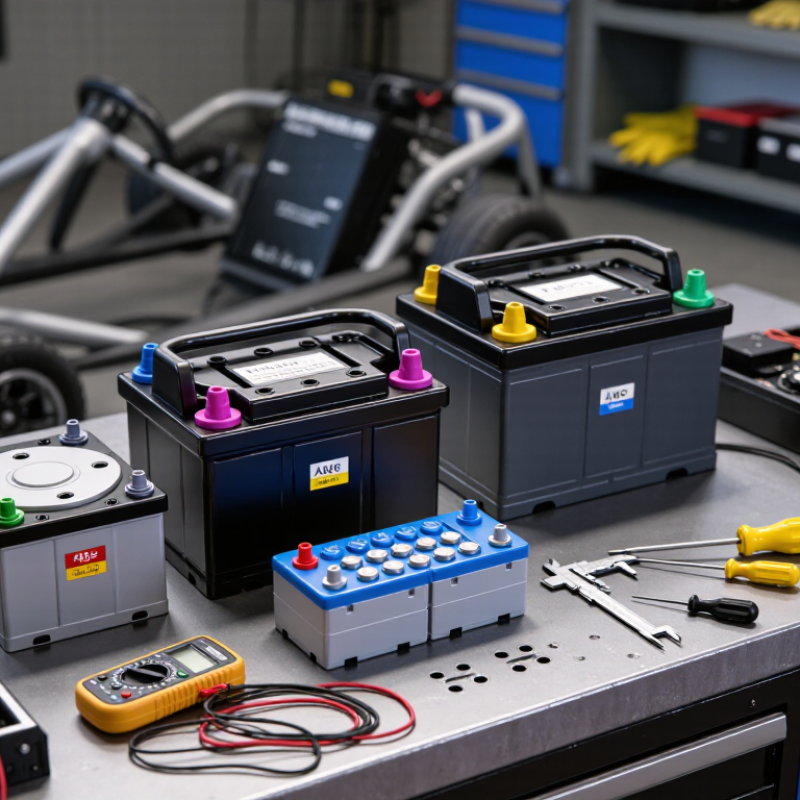
Identify the Go-Kart’s Power and Performance Requirements
Identify the motor’s nominal voltage, continuous power, and short-burst peak current before comparing batteries. A 3 kW motor on a 48 V system draws about 63 A at full power, before electrical losses. Acceleration can demand more. Check the controller’s current limit, too; a battery’s voltage may fit while its discharge rating does not. That mismatch can cause voltage sag, sluggish launches, or a protective shutdown.
Estimate energy from real driving time, not the motor’s peak rating. If a kart averages 1.5 kW for 20 minutes, it uses about 0.5 kWh; allow extra capacity for losses and reserve. Measure a typical session if possible. Stop-and-go laps, steep grades, rider weight, and tire pressure all change demand. A spreadsheet is useful, but it can miss a hot afternoon or repeated hard starts. The U.S. Advanced Battery Consortium’s 2020 electric-vehicle battery goals used 200 Wh/kg as a specific-energy benchmark; it’s a development target, not a promise for every pack. Use it only for context. For your kart, compare the battery’s continuous and peak discharge ratings, usable watt-hours, and temperature limits against measured use.
Compare Battery Types and Chemistry
A go-kart battery should match the motor or starter, not just fit beneath the seat. Check system voltage, required current, battery dimensions, and charger compatibility before comparing chemistry. Numbers matter. A battery with enough capacity can still struggle if it cannot deliver the needed current.
Lead-acid batteries, including sealed AGM types, are widely available and often cost less upfront. They are heavy, and voltage may drop noticeably under hard acceleration. Flooded designs also need careful maintenance. Lithium iron phosphate batteries usually weigh less and offer many charge cycles, but need a compatible charger and battery management system. Lithium-ion can provide high energy in a compact package, though its performance and safety requirements vary by cell chemistry.
For a recreational kart, compare usable capacity and peak-current ratings alongside price. A short track session with frequent stops may stress a battery differently from steady driving. Keep the battery secured against vibration, and leave room for cables without sharp bends. I once would have picked the lightest option; that is not always wise. A poorly matched charger can shorten battery life, even when the battery itself seems well chosen. Check the manufacturer’s specifications for operating temperature and charging limits before installation.
Choose the Correct Voltage, Capacity, and Current Rating
A go-kart battery must match the kart’s electrical system, not just fit its tray. Check the motor and controller specifications before choosing a voltage. A battery with too little voltage may deliver weak performance; too much can damage components. Keep the system voltage consistent. Also confirm that the charger is designed for the battery’s chemistry and voltage.
Capacity, measured in amp-hours (Ah), gives a rough guide to runtime. Higher capacity can mean longer sessions, but actual run time depends on rider weight, terrain, speed, and temperature. A hilly track drains a battery faster than smooth pavement. Current rating matters too: the battery must handle the motor’s continuous demand and short acceleration peaks. Check both ratings in the manufacturer’s specifications, and leave a sensible margin. I’ve found that estimates can be optimistic; real track conditions change the result.
Tips: Compare the battery, controller, motor, and charger specifications together. Check terminal size and polarity before installation. Secure the battery firmly, and inspect its cables for heat or looseness after a short test ride.
How to Choose a Battery for a Go Kart? - Choose the Correct Voltage, Capacity, and Current Rating
| Go-Kart Setup | Nominal Battery Voltage | Example Capacity | Nominal Energy | Approx. Motor Current | Suggested Continuous Battery Rating | Typical Mixed-Use Runtime |
|---|---|---|---|---|---|---|
| Light recreational kart | 24 V | 20 Ah | 480 Wh | About 21 A for a 500 W motor | At least 30 A | About 35–50 minutes |
| Medium recreational kart | 36 V | 20 Ah | 720 Wh | About 21 A for a 750 W motor | At least 30 A | About 35–50 minutes |
| Higher-speed recreational kart | 48 V | 20 Ah | 960 Wh | About 21 A for a 1,000 W motor | At least 30 A | About 35–50 minutes |
| Higher-power kart | 48 V | 30 Ah | 1,440 Wh | About 31 A for a 1,500 W motor | At least 40 A | About 35–50 minutes |
Selection notes: Approximate motor current is calculated as motor power divided by nominal battery voltage; real current can be higher because of electrical losses, acceleration, hills, and low battery voltage. Choose a pack whose continuous discharge rating meets or exceeds the kart controller’s maximum battery current, and check that its peak rating can handle the controller’s startup and acceleration demands. Runtime estimates vary with rider weight, terrain, speed, battery chemistry, and driving style. Confirm that battery voltage, chemistry, charger, controller, and motor are compatible.
Check Battery Size, Weight, and Electrical Compatibility
A go-kart battery must fit its tray and meet the electrical demands of its motor and controller. Measure the tray’s length, width, and height, including space for cables and terminal covers. Then compare those figures with the battery’s actual dimensions. A close fit can make installation awkward. Measure twice.
Weight matters, too. A heavier battery can shift the kart’s balance, especially if it sits high or far to one side. Check the kart’s load limits and mounting points before choosing. Tips: Confirm the system voltage, controller requirements, and battery chemistry. Use a compatible charger, and secure the battery so it cannot slide during turns.
Capacity affects how long the kart can run, but a larger number is not the only consideration. Check the battery’s continuous and peak current ratings against the motor and controller specifications. A battery may fit physically yet struggle under acceleration. Leave room for safe cable routing, and check that terminals cannot touch the frame. It is easy to focus on runtime and overlook mounting details. I would recheck every measurement before ordering; small differences can matter. When specifications are unclear, ask a qualified technician to verify compatibility.
How to Choose a Battery for a Go-Kart
Compare the approximate mass of common 12V batteries in a similar 10Ah capacity class.
These representative masses are approximate and vary by battery design. Before buying, check the battery’s dimensions and mounting fit, then confirm its nominal voltage matches the motor controller and that its BMS and discharge rating meet the kart’s current demand. Also verify the charger is compatible with the battery chemistry; a 12.8V LiFePO₄ battery may not suit every system designed for lead-acid batteries.
Assess Charging Needs, Safety, and Maintenance
A go-kart battery should match the kart’s required voltage and fit securely in its battery tray. Check the motor’s current draw and estimate how long each session lasts. A higher-capacity battery may extend driving time, but it also adds weight. A simple runtime estimate can be imperfect; hills, rider weight, and repeated acceleration all affect power use. Choose a charger approved for the battery’s chemistry and voltage. A charger that merely fits the connector may still be unsuitable.
Charging needs deserve a safe, practical setup. Charge in a dry, ventilated area, away from fuel, loose tools, and hot surfaces. Inspect cables and connectors for cracks, corrosion, or unusual warmth. Stop charging if the battery swells, leaks, smells unusual, or becomes excessively hot. Follow the battery maker’s instructions for charging and storage, since lithium and lead-acid batteries need different care. Never guess at charging settings.
Tips: Check charge level before riding, and let a hot battery cool before charging. Keep terminals clean and firmly connected. For seasonal storage, use the specified charge level and recheck it periodically. A small log of charge times and ride length can reveal gradual capacity loss. It is easy to forget this check. When performance drops sharply, inspect the battery and wiring before assuming the motor is at fault.
