

How to Choose the Right Machine Safety Fence?
Choosing the right Machine Safety Fence begins with understanding the machine, not browsing product catalogs. A practical assessment should examine moving parts, operator access, material flow, cleaning routines, and emergency stopping points. Walk around the equipment during normal production. Watch where hands, tools, pallets, and maintenance staff actually move. These details often reveal hazards that drawings overlook.
A suitable fence should create a reliable physical boundary without blocking essential visibility. Mesh size, panel height, post strength, gate location, and floor anchoring all matter. A poorly positioned gate can encourage shortcuts. A weak anchor can make a strong panel ineffective. Interlocked access doors may be necessary where entry is frequent or dangerous, but they must match the machine’s control system and risk assessment. Components should also support inspection, cleaning, and replacement over time. Look for designs aligned with recognized safety principles, such as ISO 14120, while confirming applicable local requirements with a qualified safety professional.
Do not choose by price alone. Consider installation quality, maintenance access, corrosion resistance, spare parts, and future machine changes. A fence that fits today may obstruct tomorrow’s conveyor upgrade. That is easy to miss.
There is no universal enclosure. Even experienced teams can overlook unusual maintenance tasks or informal operator habits. Review the layout with operators, technicians, and safety specialists before approval. Then test the finished installation under realistic conditions. A dependable Machine Safety Fence is not merely a barrier; it is part of a wider safeguarding system, and its value depends on thoughtful design, correct installation, and consistent use.
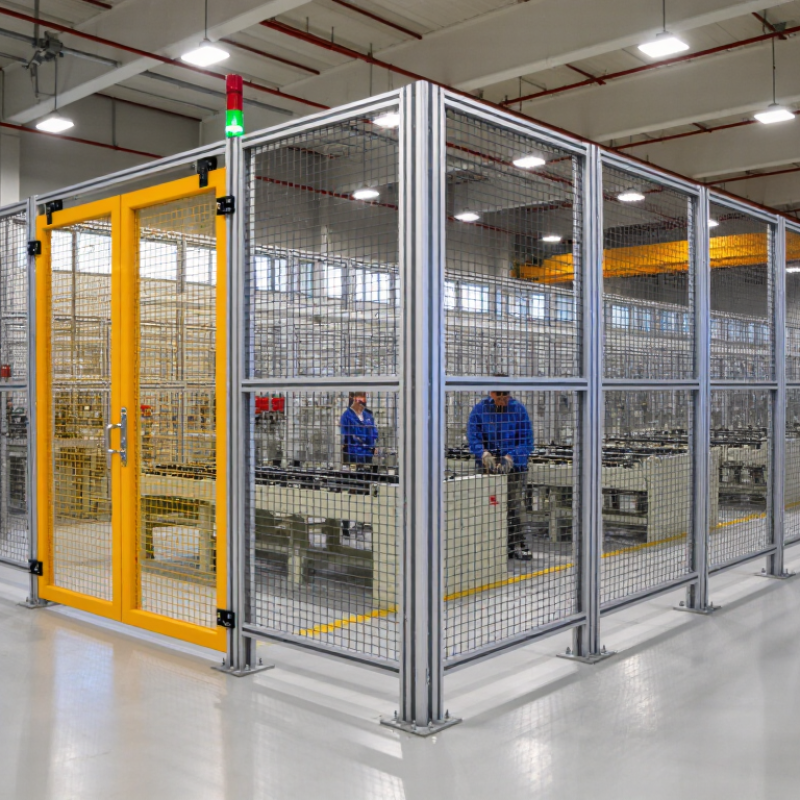
Define Machine Safety Fence Needs Under ISO 14120 and OSHA 1910.212
How to Choose the Right Machine Safety Fence?
Define Machine Safety Fence Needs Under ISO 14120 and OSHA 1910.212
Machine safety fencing begins with risk, not panel height. ISO 14120 requires guards to be suitable, stable, and difficult to bypass. OSHA 1910.212 requires protection from points of operation, ingoing nip points, rotating parts, and flying debris. Map every access route around the machine. Include doors, loading areas, maintenance gaps, and spaces beneath panels.
Small gaps matter.
A practical assessment should record reach distance, tool access, line-of-sight, and stopping time. Interlocked access doors may be necessary where operators enter hazardous zones. Fixed guards can suit areas needing no routine access. The fence should resist impact and remain secure after repeated opening, cleaning, and vibration. I have seen attractive barriers fail because a pallet could approach from behind.
Design details affect real protection.
The U.S. Bureau of Labor Statistics recorded 5,283 fatal occupational injuries in 2023, showing why machine guarding demands disciplined verification. OSHA’s Machine Guarding eTool also identifies amputations and serious injuries as continuing hazards around unguarded machinery. These reports do not replace a site-specific risk assessment. They provide context.
Check visibility, emergency access, and reset controls. Then test normal and abnormal conditions. A compliant-looking fence is not automatically safe. Reflect honestly on operator behavior, because convenience can quietly defeat good engineering. Review the installation against ISO 14120 and OSHA 1910.212 before production begins, and document every unresolved assumption.
How to Choose the Right Machine Safety Fence? - Define Machine Safety Fence Needs Under ISO 14120 and OSHA 1910.212
| Safety-Fence Need | Assessment Criteria | Recommended Fence Feature | ISO 14120 Consideration | OSHA 1910.212 Consideration | Verification Method |
|---|---|---|---|---|---|
| Hazard type | Identify crushing, shearing, cutting, entanglement, impact, ejection, or hot-surface hazards. | Use a rigid perimeter guard with panels selected for the specific hazard and expected energy. | The guard should prevent access to hazardous areas and be suitable for the foreseeable conditions of use. | Machine guarding must protect operators and other employees from point-of-operation and other machine hazards. | Complete a documented task-based risk assessment and hazard inventory. |
| Access frequency | Determine whether access is never required, occasional, or frequent for production, setup, cleaning, or maintenance. | Use fixed panels for infrequent access and guarded doors or gates where routine access is necessary. | The choice of fixed or movable guarding should reflect the need for access and the risk associated with that access. | The guard must prevent employee access to the danger zone during operation. | Review normal and abnormal tasks, including jams and adjustments. |
| Fixed or movable guard | Assess whether the guard must be removed for access or can remain permanently installed. | Select fixed guards when access is unnecessary; use movable guards with appropriate control measures when access is required. | Fixed guards should require tools for removal; movable guards should be designed according to their access and risk conditions. | Guards must be secured and must not create an additional hazard. | Check removal method, fasteners, hinges, latches, and access-control arrangements. |
| Guard height and reach | Measure the hazard location, required clearance, nearby platforms, and possible reaching paths. | Set panel height and distance from the hazard using the applicable reach and safety-distance assessment; do not select height by appearance alone. | Safety distances and openings should prevent persons from reaching the danger zone through, over, under, or around the guard. | The guard must prevent hands, arms, or other body parts from reaching moving parts or the point of operation. | Measure openings and reach distances; consider access from all sides and elevated work positions. |
| Mesh or opening size | Evaluate the smallest opening that could permit a person or body part to reach the hazard. | Choose mesh or panel openings together with the required separation distance; smaller openings do not automatically replace distance assessment. | Openings and distances should be selected to prevent access to hazardous zones, considering foreseeable misuse. | The guard must be designed and constructed so employees cannot reach the danger zone. | Use a calibrated opening gauge and document the measured opening and separation distance. |
| Impact and ejected-material resistance | Determine whether the machine can eject tools, workpieces, fragments, chips, or other materials. | Use panels, posts, fixings, and support spacing rated or tested for the foreseeable impact load; add solid panels where containment is needed. | Guard construction should withstand expected impacts and loads without creating a new hazard. | The guarding arrangement must protect employees from hazards generated by the machine operation. | Review machine energy, material properties, worst-case ejection path, and panel deflection. |
| Gate and door control | Identify every access gate and determine whether hazardous motion can continue after opening. | Use an interlocked gate where access is required during the machine lifecycle; consider guard locking when hazardous motion persists after access. | Movable guards should be designed so opening or removal does not expose people to unacceptable risk. | The guard must protect employees during operation; control-system measures may be needed where opening creates access to moving hazards. | Test opening, restart prevention, stopping time, and access to residual energy. |
| Bypassing and defeat resistance | Consider foreseeable attempts to climb, reach around, remove, defeat, or bypass the fence. | Use tamper-resistant fasteners where justified, controlled key access, coded devices, protected switches, and layouts that discourage bypassing. | Guard design should minimize opportunities for circumvention and should not be easily defeated. | Guards must be secured and must not be easily bypassed or rendered ineffective during use. | Perform a documented defeat-and-misuse review during commissioning and periodic inspections. |
| Visibility and operator awareness | Determine whether operators need to observe the process, indicator lights, tooling, or material flow. | Use transparent or open-panel sections only when they maintain the required safety distance and containment performance. | Guard design should support visibility where necessary without reducing protective performance. | The guard must protect employees while allowing safe operation and necessary observation. | Check sight lines, glare, lighting, and whether visibility encourages unsafe access. |
| Cleaning and maintenance | Identify cleaning points, lubrication locations, tooling changes, inspection tasks, and lockout/tagout requirements. | Provide controlled access, removable sections requiring tools, maintenance gates, and adequate working clearance. | Guards should remain effective during foreseeable maintenance and should not introduce ergonomic or other hazards. | Employees must be protected from machine hazards; hazardous energy-control procedures apply when servicing requires exposure. | Validate the maintenance procedure, isolation points, access route, and post-maintenance guard restoration. |
| Floor, foundation, and layout | Check floor condition, anchor locations, aisles, emergency routes, conveyors, utilities, and nearby equipment. | Use stable posts, suitable anchors, protected cable routing, and a layout that prevents access around the fence ends. | The guard should be stable, durable, securely fixed, and suitable for its installation environment. | Guards must be securely attached and must not create hazards such as sharp edges or obstructed access. | Inspect anchor torque, fence stability, clearances, walkways, and end-of-fence gaps. |
| Materials and environment | Evaluate corrosion, moisture, chemicals, temperature, washdown, ultraviolet exposure, dust, and static-electricity concerns. | Specify materials, coatings, fasteners, and transparent panels compatible with the environment and cleaning method. | Construction materials should retain protective performance throughout the expected service conditions. | The guard must remain effective and must not introduce additional hazards under workplace conditions. | Review material data, chemical compatibility, corrosion condition, and inspection intervals. |
| Emergency access and escape | Determine whether personnel could become trapped inside the guarded area and whether emergency egress is required. | Provide appropriately located emergency exits, escape releases, or internal reset arrangements where the risk assessment requires them. | Guarding should account for foreseeable use, access, and the possibility of persons entering the protected area. | The safeguarding arrangement must not expose employees to additional hazards or prevent safe response to an emergency. | Conduct a walk-in and entrapment assessment for every accessible guarded zone. |
| Signage and instructions | Identify residual risks, restricted access, required PPE, lockout/tagout points, and emergency procedures. | Install durable warning labels and operating instructions where residual risks remain after guarding. | Information and markings should support safe use but should not be relied upon as a substitute for a guard. | Employees must be protected by physical safeguarding; warnings supplement, rather than replace, effective guarding. | Verify label visibility, language suitability, durability, and consistency with procedures. |
| Inspection and lifecycle maintenance | Define inspection frequency based on use, impact exposure, environmental conditions, and modification history. | Create an inspection checklist covering panels, posts, anchors, gates, interlocks, labels, and unauthorized modifications. | The guard should remain effective, durable, and maintainable throughout its intended life. | Guards must remain in place and effective while the machine is in use. | Record inspection results, corrective actions, functional tests, and change-control reviews. |