

Quality Mold

How to Choose the Right Overhead Crane Wire Rope?

Choosing an Overhead Crane Wire Rope is not simply a matter of matching diameter. The rope must work with the crane’s hoist, sheaves, drum grooves, reeving arrangement, and operating conditions. A rope that looks substantial on a warehouse floor may still bend poorly over a small sheave. That mismatch can accelerate wear. Small details matter.

Wire-rope historian Donald Sayenga’s concise description, “A wire rope is a machine,” is a useful reminder: its wires and strands work together under load. Selection should consider rated capacity, rope construction, core, lay, rotation behavior, and the manufacturer’s specified requirements. Duty cycle matters, too. A crane making frequent lifts in a dusty plant faces different demands from one used occasionally in a clean workshop. There is no universal best rope.

This guide explains how to compare those factors and check compatibility with the crane’s documentation. It also covers environmental exposure, lubrication, installation, and inspection signs such as broken wires, corrosion, or flattened sections. A visual check helps, but it cannot replace qualified inspection or the applicable discard criteria. Even careful buyers can overlook drum-groove condition; that deserves a closer look. The goal is a well-matched rope, not simply the lowest price or highest headline strength. When specifications conflict or are unclear, consult the crane manufacturer or a qualified lifting-equipment professional before ordering.
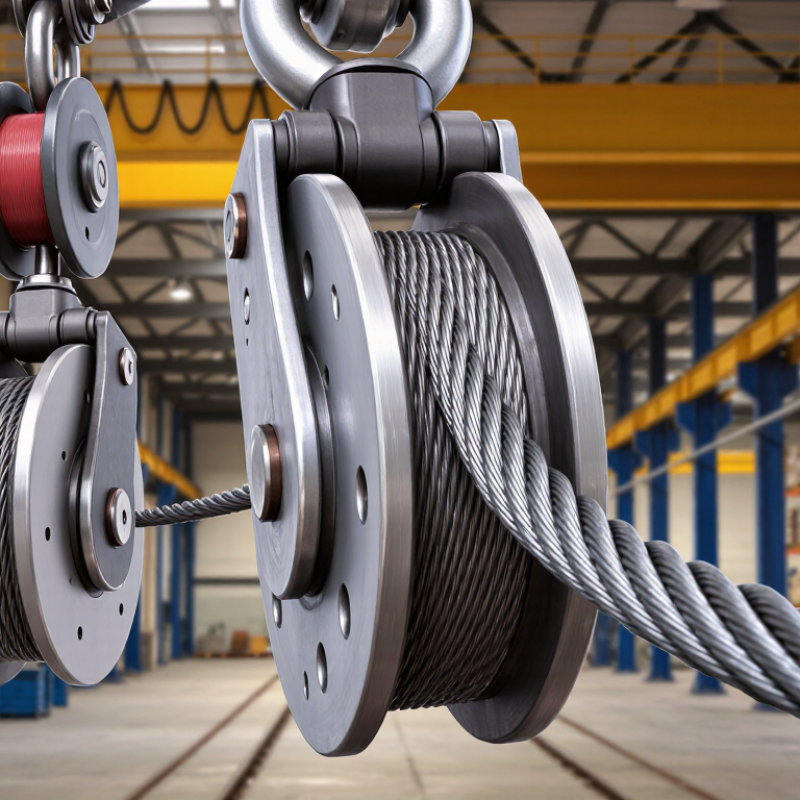
How to Choose the Right Overhead Crane Wire Rope?

Identify the Crane Type and Its Operating Requirements

A wire rope that suits a light-duty workshop hoist may not perform well on a high-cycle bridge crane. Start by identifying the crane type and how its rope travels. Bridge and gantry cranes often use hoists with defined drum grooves and reeving patterns; monorail systems may have different routing and space limits. Check the crane manual for the required rope diameter, construction, lay, and end connection. A close visual match is not enough.

Then describe the actual work. Record the rated load, lift height, operating speed, and approximate lifts per hour. Frequent starts and stops, long lifts, or heavy side pull can change wear patterns. So can dust, moisture, heat, and outdoor exposure. Details matter. Ask whether the rope must resist rotation, and confirm that its construction matches the drum and sheaves. A rope that bends repeatedly over small sheaves may wear faster than expected.

Use the crane maker’s specifications as the baseline, then compare them with operating conditions and inspection findings. Look for broken wires, corrosion, crushing, and uneven winding, but do not judge serviceability by appearance alone. Measurements and records help. In practice, operating logs are often incomplete, so treat estimates cautiously and have a qualified crane professional verify the selection before installation.

Compare Wire Rope Constructions and Core Types

For overhead cranes, compare rope construction against the actual sheave path and lifting cycle. The Wire Rope Users Manual, published by the Wire Rope Technical Board, describes 6x19 and 6x36 as construction classes. The 6x19 class commonly has 15–26 wires per strand; 6x36 has 27–49. More wires usually allow tighter bending and better fatigue performance, while fewer, thicker wires tend to resist abrasion better.

That is a trade-off, not a guarantee. A dusty, abrasive hoist may wear a flexible rope quickly, while repeated bending can fatigue a stiffer one.

Core choice matters too. A fiber core (FC) is generally more flexible and can retain lubricant, but it offers less support under high crushing pressure. An independent wire rope core (IWRC) provides a steel center that better resists crushing and can increase rope strength. Check the manufacturer’s rope data against the crane’s sheave diameter, drum grooves, and load cycle; small mismatches matter.

ISO 4309 inspection criteria vary by rope category and lay length, so there is no single broken-wire limit for every rope. A neat rule can mislead: inspect the installed rope and operating conditions, not just its label.

Select the Rope Diameter, Grade, and Breaking Strength

Choosing an overhead crane wire rope starts with diameter, but diameter alone does not define suitability. Check the crane manufacturer’s specifications and the rope’s compatibility with the sheaves and drum. A rope that is too large may bend poorly; one that is too small may wear quickly. Measure twice. Include the reeving arrangement, hook block, and any attachments when assessing the supported load.

Grade affects the rope’s strength and performance, but a higher grade is not automatically the best choice. Consider the crane’s duty cycle, operating speed, and exposure to moisture, dust, or heat. For example, frequent lifting in a dusty workshop can accelerate wear between strands. Inspect the rope construction and maintenance requirements, too. Small details matter. A neat specification sheet may still miss awkward site conditions, so check the actual installation.

Compare the rope’s certified minimum breaking strength with the required working load and the applicable design factor. Breaking strength is not a safe lifting load. Account for dynamic effects, starts and stops, and the number of supporting rope parts. Do not estimate these values from diameter alone. Confirm the final selection against the crane documentation and a qualified supplier’s data. If the figures seem close, pause and verify them; a rushed match can overlook important limits.

How to Choose the Right Overhead Crane Wire Rope? — Select the Rope Diameter, Grade, and Breaking Strength

Use this guide to compare key selection factors. Final rope specifications must match the crane design, applicable requirements, and rope manufacturer’s documentation.
Selection factor What to check Practical guidance How to verify
Nominal diameter The rope diameter specified for the crane’s sheaves, drum, and reeving system. Use the diameter required by the crane design. A larger diameter is not automatically a suitable upgrade: it must fit the grooves and drum and meet applicable minimum sheave-to-rope diameter requirements. Check the crane manual and rope specification. Measure a new or in-service rope across the widest outer strands using a suitable rope-diameter gauge; do not measure across a valley between strands.
Rope construction Strand arrangement, core type, and whether the rope is rotation-resistant. Common crane rope constructions include 6-strand ropes with fibre or independent wire rope cores, and rotation-resistant constructions. The correct type depends on reeving, lift height, load control, and crane design. Match the construction and core stated on the crane documentation. Do not substitute a rotation-resistant rope or a different core type without approval.
Rope grade The rope tensile-strength grade, commonly designated in N/mm² (MPa), such as 1770, 1960, or 2160. A higher grade can provide a higher minimum breaking force for a given diameter and construction, but it is not by itself proof that a rope is compatible with the crane or appropriate for the duty. Confirm the grade on the rope certificate and verify it against the crane manufacturer’s requirements and the applicable rope standard.
Minimum breaking force The certified minimum breaking force (MBF) for the complete rope, not the tensile-strength grade alone. Required MBF depends on the maximum rope-line pull, reeving arrangement, design factor, and governing requirements. There is no single universal MBF for a given diameter across all rope constructions and standards. Use the MBF on the manufacturer’s certificate or applicable product table for the exact diameter, construction, core, and grade. Do not estimate it from diameter alone.
Design factor and line pull The maximum tension in the rope line and the design factor required for the crane application. As a basic screening relationship, required MBF must be at least the required design factor multiplied by the maximum rope-line pull. The design factor must come from the applicable crane design standard or manufacturer—not from a generic rule of thumb. Have a qualified crane engineer confirm the governing load case, reeving efficiency, dynamic effects, and required design factor.
Sheaves, drum, and operating duty Groove profile, sheave and drum diameters, fleet angle, bending cycles, speed, and operating environment. Frequent bending, small sheaves, high duty cycles, abrasion, heat, and corrosion can affect rope life. Rope construction and lubrication should suit the actual duty and environment. Compare the proposed rope with the crane manufacturer’s limits and inspection criteria. Check that the drum and sheave grooves are compatible and in serviceable condition.
Identification and traceability Rope diameter, construction, grade, core, lay, coating or finish, and manufacturing documentation. Keep the replacement rope’s specification consistent with the approved crane design. Changes can affect performance, compatibility, and inspection requirements. Verify the rope marking, certificate, and purchase specification before installation; retain records for maintenance and inspection.

Important: This guide is for preliminary comparison, not a rope-sizing calculation. Select a replacement using the crane manufacturer’s specification and the applicable regulations and standards. If the original specification is unavailable, consult a qualified crane engineer before ordering or installing a rope.

Check Compatibility with the Crane’s Sheaves and Drum

A rope can fit the drum and still be a poor match. Check the sheave’s pitch diameter against the rope diameter, written as the D/d ratio. ISO 16625:2013 sets out selection criteria for crane ropes, drums, and sheaves, with the required ratio depending on rope construction and crane duty. Do not copy a ratio from another crane without checking its duty classification and reeving. A smaller-than-specified sheave bends the rope more sharply, accelerating fatigue and wire breaks. That matters.

Inspect the groove, too. The Wire Rope Technical Board’s Wire Rope Users Manual recommends a sheave-groove radius around 0.53–0.54 times the rope diameter. For a 20 mm rope, that means roughly 10.6–10.8 mm. A tight groove can pinch and wear the rope; an oversized groove gives it poor support. Check the drum grooves and winding pattern for crossovers, crowding, and uneven layers. These details are easy to miss on a drawing. Measure the worn sheave, not just the replacement part’s catalogue dimensions. Confirm the rope maker’s tolerances and the crane manual before ordering; nominal diameter alone does not prove compatibility.

How to Choose the Right Overhead Crane Wire Rope? Check Compatibility with the Crane’s Sheaves and Drum

Example compatibility check for a 20 mm wire rope. The D/d ratio is the sheave or drum pitch diameter (D) divided by the rope diameter (d).

Example: Pitch diameters of 400, 500, and 600 mm give D/d ratios of 20, 25, and 30, respectively, for a 20 mm rope. These figures illustrate the calculation only; they are not universal minimum limits. Check the crane and rope manufacturers’ requirements and the applicable standard, including groove profile and rope construction, before selecting a rope.

Assess Inspection, Maintenance, and Replacement Requirements

An overhead crane wire rope should be judged by its condition over time, not just its appearance on one shift. Set inspection intervals based on duty cycle, environment, and the crane’s instructions. A rope moving all day in a dusty steel shop needs closer attention than one used occasionally indoors. Small changes matter.

During inspections, look for broken or protruding wires, flattened strands, kinks, birdcaging, corrosion, and unusual diameter loss. Check sections that pass over sheaves and wrap onto the drum, where wear can be concentrated. Listen for new noises and note uneven winding, too. A clean rag can help reveal rust or grease packed with grit. Visual checks are useful, but they cannot expose every internal defect; trained personnel may need to assess uncertain damage.

Keep dated records with the rope’s location, operating hours where available, findings, and actions taken. Maintenance may include cleaning and applying a compatible rope lubricant, while also checking sheaves, grooves, and alignment. Replace the rope when inspection findings meet the applicable removal criteria, or when its history raises a credible concern. Those limits vary by rope construction and service conditions, so avoid relying on a single universal broken-wire count. A neat log does not guarantee a safe rope. It does make missed changes easier to question.