

Quality Mold

How to Choose a Professional Kart Supplier for Your Business

Choosing a Professional Kart supplier is a business decision that reaches far beyond the purchase price. Equipment reliability affects daily operations, customer experience, maintenance time, and the cost of keeping a track running. Grand View Research’s Go-Kart Market Size, Share & Trends Analysis Report estimated the global market at USD 121.8 million in 2022 and projected a 3.9% compound annual growth rate from 2023 to 2030. This is a market-research estimate, not an audited count of every kart sale. Still, it signals a sector where supplier quality and support can influence long-term returns. A polished brochure is not proof. Details matter.

A careful evaluation should consider chassis construction, engine or electric-drive options, parts availability, warranty terms, and technical support. Ask how quickly common wear parts can be supplied, and request clear service documentation before committing. If possible, inspect a kart in person: look at welds, steering components, seat adjustment, and how easily routine checks can be performed. Compare the supplier’s specifications with your intended use, expected traffic, and staff capabilities. No supplier is perfect. Even experienced buyers can overlook support costs when a quoted price looks attractive. Review references from comparable operators, clarify delivery and training arrangements, and document what the warranty does—and does not—cover. These practical checks help turn a promising sales conversation into a dependable business partnership.
How to Choose a Professional Kart Supplier for Your Business

Define Fleet Requirements Against FIA Karting’s 1,400 mm Maximum Width

Choosing a professional kart supplier starts with a fleet plan, not a catalogue. Set the expected number of karts, driver range, and daily operating hours. Then compare each model’s stated overall width with FIA Karting’s 1,400 mm maximum-width reference. Treat that figure as a limit to verify, not a substitute for checking the technical rules that apply to your class and event.

Ask the supplier for a dimensioned drawing showing the widest point, including tires and bodywork. Confirm whether the measurement applies to the kart in its operating setup. Small errors matter. A few millimetres can affect trailer spacing, workshop access, and how safely karts move through a busy pit area. Request written specifications, and check that replacement parts do not change the overall width.

Before ordering a full fleet, inspect or measure a sample kart yourself. Measure it yourself. Compare the result with the supplier’s drawing, and note tire type, wheel alignment, and any adjustable components. Even a careful estimate can miss a protruding axle or body panel; that is an easy detail to overlook on paper. Allow practical clearance beyond the stated maximum for transport and storage, while keeping the applicable technical limit in view. A supplier who answers measurement questions precisely makes fleet planning easier.

Verify Leisure-Kart Safety Compliance with EN 16230-1:2013+A1:2014

How to Choose a Professional Kart Supplier for Your Business

For leisure-kart operations, ask suppliers for documentation showing how the exact kart model was assessed against EN 16230-1:2013+A1:2014. This European standard covers safety requirements and test methods for leisure karts. Details matter. A certificate for a different model or configuration may not tell you much about the karts you plan to buy.

Request the relevant test reports or conformity records, and check the model, configuration, standard edition, and assessment date. Ask who conducted the assessment and whether later design changes affect the documents. A polished file can still leave questions. If answers are vague, pause and seek clarification before placing an order.

Paperwork is only part of the review. Inspect a sample kart and look closely at its brakes, steering, guards, and emergency controls. Ask how routine checks and repairs are documented, and whether operating instructions are clear for your staff. Good suppliers should explain how their safety claims connect to real maintenance procedures. Even careful checks have limits; compliance with this standard does not replace checking applicable local requirements or assessing your track’s specific risks.

Assess Supplier Quality Systems Against ISO 9001:2015

When choosing a kart supplier, treat ISO 9001:2015 as a framework to examine, not a quality guarantee. Ask to see the current certificate, its scope, issuing body, and expiry date. The scope should cover the manufacturing site and relevant kart components, not only an office. Request a walkthrough of how orders move from design review to final inspection. Look for controlled drawings, revision records, and clear sign-offs at each handoff. Small gaps matter. A steering part made to an outdated drawing can fit poorly, even when paperwork appears complete. Check how incoming steel, welding materials, and purchased brake parts are identified and traced.

During a site visit, ask operators how they handle a rejected weld or a measurement outside tolerance. Their answers should match documented procedures, and records should show containment, root-cause review, and corrective action. Useful evidence includes calibrated torque tools, inspection logs, training records, and a sample batch trace from raw material to dispatch. Ask for evidence. Compare recent nonconformance reports with the changes made afterward; recurring issues deserve direct discussion. Even a careful audit can miss informal workarounds, so one visit is only a snapshot. ISO certification supports process discipline, but it does not prove every kart suits your operating conditions. Ask how the supplier checks performance under your expected load, terrain, and service schedule. If a record is incomplete, note it rather than assuming intent.

Compare Chassis, Powertrain, Spare-Parts, and Service Specifications

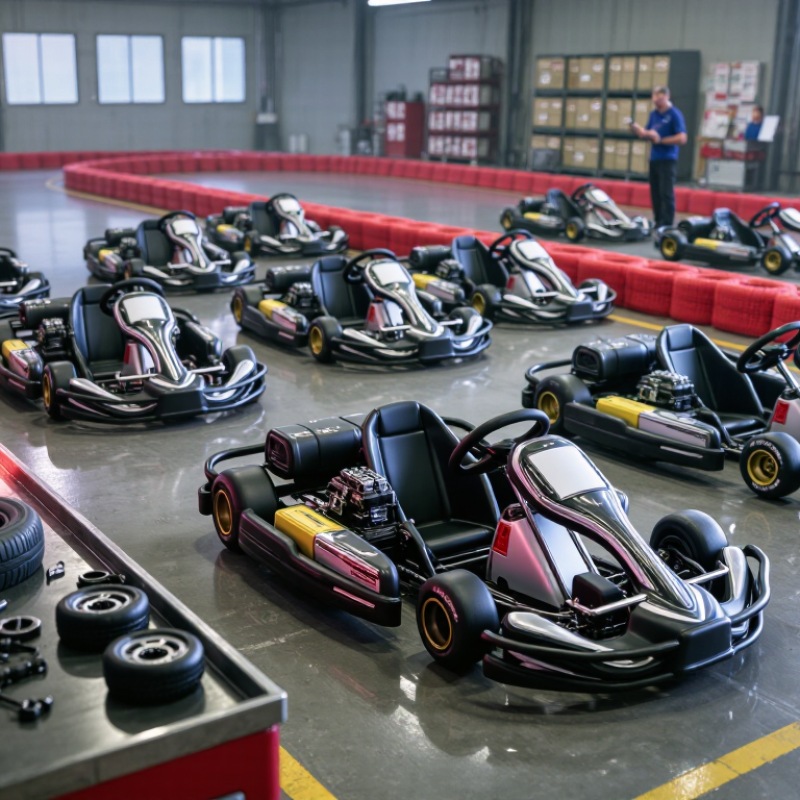
A professional kart supplier should explain how its chassis suits your track, driver mix, and expected daily use. Compare frame material, weld quality, axle options, and adjustment range, not just the listed weight. Ask for written dimensions and maintenance intervals. If possible, inspect a kart after a full day of operation; fresh paint can hide wear around mounting points. A small detail matters. Check whether common parts, such as steering joints and brake pads, are easy to reach and replace. It is tempting to choose the lightest chassis, but that may not be the best choice for a busy rental fleet.

Compare powertrain output, cooling needs, and routine service requirements against your operating schedule. Request clear figures for energy use or fuel consumption, plus expected service intervals under similar conditions. Then review the spare-parts list: which items are stocked locally, what are typical lead times, and are part numbers documented? Ask the supplier to demonstrate a basic repair, such as replacing a brake cable or drive component. Service support should include practical manuals, technician training, and a named contact for urgent questions. Get response times in writing. Still, no checklist predicts every vibration or unusual wear pattern, so leave room to review operating data after delivery and adjust your maintenance plan.

How to Choose a Professional Kart Supplier

Suggested evaluation weights for comparing documented chassis, powertrain, spare-parts, and service specifications.

These are proposed buyer-defined weights, not industry survey results. Adjust them to match your fleet, operating conditions, and support needs.

Calculate Total Cost of Ownership Across Purchase, Maintenance, and Downtime

A kart’s purchase price is only the first line on the cost sheet. Compare a three-year total that includes delivery, tires, brake parts, batteries or engine servicing, labor, and scheduled maintenance. Ask suppliers for written parts prices, service intervals, and typical lead times. A low-priced kart can become costly when a replacement hub or controller is unavailable. The U.S. Department of Energy’s Operations & Maintenance Best Practices Guide estimates reactive maintenance can cost three to four times more than preventive maintenance. Treat that as a planning benchmark, not a kart-specific guarantee. Real wear depends on track surface, driver volume, and care.

Put downtime into the same calculation. Estimate the hourly contribution lost when a kart is unavailable, then multiply it by expected repair hours and the number of affected karts. Siemens’ 2024 True Cost of Downtime report estimated unplanned downtime costs the world’s 500 largest companies about $1.4 trillion annually, roughly 11% of revenue. That industrial figure is not a karting forecast, but it shows why availability deserves a price. Ask each supplier about diagnostic support, stocked service parts, and repair response times. Forecasts are imperfect; driver damage and seasonal demand can upset them. Keep a contingency line, and compare the supplier’s expected service life with the cost of replacement parts.