

Top Conical Burr Hand Grinder Suppliers Worldwide
Choosing among the Top Conical Burr Hand Grinder Suppliers Worldwide takes more than comparing prices or polished product photos. Buyers should examine burr material, adjustment range, build quality, replacement-part access, and the consistency of the grind. A well-made Conical Burr Hand Grinder should turn smoothly and produce grounds suited to different brewing methods, from a fine espresso-style setting to a coarser pour-over grind. Small details matter. A loose adjustment ring can frustrate daily use.
Coffee educator James Hoffmann is often associated with the practical principle, “The grinder is the most important piece of coffee equipment.” The wording is widely repeated, but buyers should verify quotations before treating them as exact. The underlying point still holds: grinder performance shapes what a brewer can extract from coffee. In this guide, we compare suppliers by product design, available specifications, manufacturing experience, and support for parts and service. We also consider how clearly each supplier explains its materials and quality checks. Those details are not always easy to confirm from a listing alone. That is worth remembering. A polished description cannot replace hands-on testing, and supplier claims deserve careful review. Our aim is to help readers identify credible manufacturers and distributors, ask sharper questions, and choose a hand grinder that fits real brewing needs.
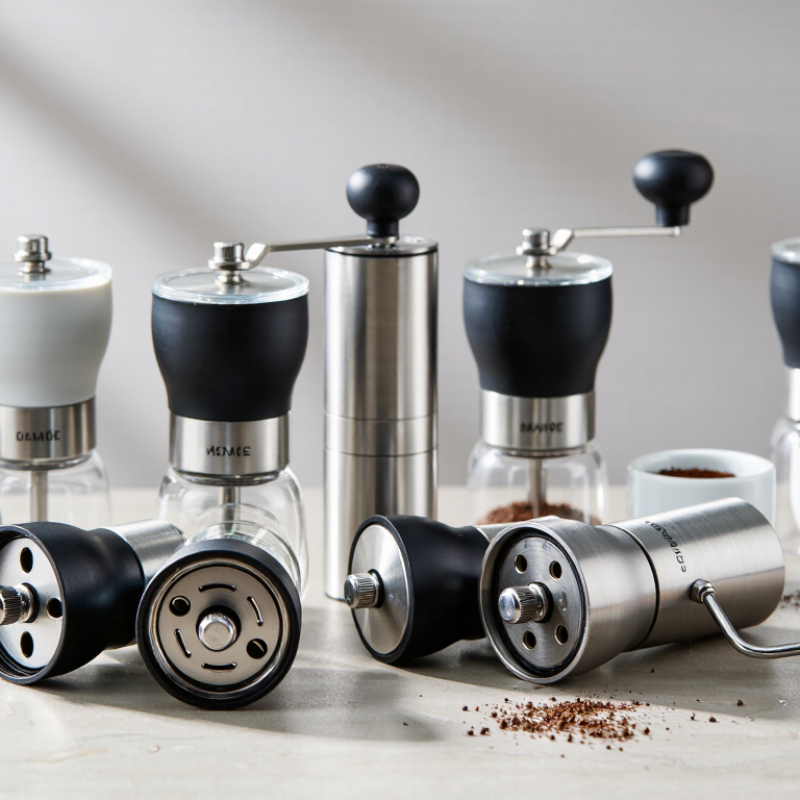
What a Conical Burr Hand Grinder Is and How It Works
A conical burr hand grinder uses two cone-shaped grinding surfaces to break coffee beans into smaller particles. One burr turns when you rotate the handle; the other stays fixed. Whole beans fall between them and are crushed as the space narrows toward the outlet. This differs from blade grinding, which chops beans unevenly.
The adjustment mechanism changes the gap between the burrs. A narrower gap generally produces finer grounds for espresso-style brewing, while a wider setting suits coarser methods such as French press. The exact result depends on the grinder’s design and burr alignment. Small adjustments matter. Turn the crank steadily, and grounds collect in a cup beneath the burr chamber.
A hand grinder needs no motor, but grinding takes physical effort, especially with dense beans or fine settings. That effort can be useful: it encourages a slower routine and makes the grinding process easy to observe. Still, hand grinding is not automatically consistent. Worn burrs, loose parts, or a rushed turn can affect particle size. Brush away leftover grounds regularly, and check that adjustment parts remain secure. A little unevenness may remain. That is worth noticing, not disguising.
Key Features That Define a Quality Hand Grinder
A quality hand grinder should produce a consistent particle bed, not merely feel smooth in the hand. Conical burr alignment matters: uneven gaps can create both fine dust and oversized fragments. In the cup, that mix may cause uneven extraction. The Specialty Coffee Association’s Brewing Control Chart places the commonly cited target at 18–22% extraction yield, with brewed coffee strength around 1.15–1.35% total dissolved solids. These are reference ranges, not a promise that every bean or brewing method will taste best at the same setting.
Look for durable burrs, a stable central axle, and clear, repeatable adjustment steps. A grinder that clicks predictably makes it easier to dial in a pour-over or espresso-style brew. It should also be comfortable to hold, with enough handle leverage to grind without wobble. Small details matter: a lid that stays shut, a grounds cup that threads cleanly, and burrs that are accessible for brushing. Research published in Matter by Hendon and colleagues in 2020 showed how grind size and particle distribution can affect espresso extraction and flow. It supports a practical point: adjustment range is useful only when settings remain consistent. A little play in the axle may be easy to miss. It can still change the cup. Check that yourself.
Top Conical Burr Hand Grinder Suppliers Worldwide: Key Features of a Quality Hand Grinder
Indicative specification ranges commonly found in manual coffee grinders. Actual specifications vary by model; use these figures as a comparison guide, not supplier rankings.
How to Evaluate Conical Burr Hand Grinder Suppliers Worldwide
When evaluating conical burr hand grinder suppliers worldwide, check more than product photos and advertised burr materials. Ask for particle-size distribution data, burr alignment tolerances, and repeatability results across several grind settings. A sample test helps: grind the same dose at a coarse setting, then inspect the grounds for excess fines and visible inconsistency. Ask how the supplier measures these results. A polished specification sheet is not a substitute for a documented test method.
Market context matters, but it does not verify a supplier. The International Coffee Organization estimated world coffee consumption at 177.0 million 60-kilogram bags in coffee year 2023/24. That scale suggests broad demand, not uniform manufacturing quality. Request batch inspection records, material certificates for food-contact parts, and evidence of a quality-management system, such as a current ISO 9001 certificate. Verify the issuing body and certificate scope. Also compare sample units from different production batches; one good grinder proves little.
Assess practical use and serviceability. Turn the adjustment dial with a full dose loaded, check whether it slips, and record the number of turns between settings. Ask for spare-burr availability, replacement instructions, and written warranty terms. Test packaging with a sample shipment, since a bent shaft can arrive despite careful machining. Some suppliers may resist sharing detailed tolerances. That is worth noting, though not automatically disqualifying. Evaluate what they can document, and keep your own test notes.
Top Conical Burr Hand Grinder Suppliers Worldwide - How to Evaluate Conical Burr Hand Grinder Suppliers Worldwide
| Evaluation Dimension | Weight | What to Check | Evidence to Request | Strong Supplier Indicators |
|---|---|---|---|---|
| Burr design and material | 20% | Confirm the burr geometry, material, finish, and replacement availability. Conical burrs may be made from hardened steel or ceramic; neither material alone guarantees better results. | Technical drawings, material specifications, burr-life testing method, and replacement-part details. | Provides clear specifications, consistent replacement parts, and repeatable test results for the intended grind range. |
| Grind adjustment and range | 15% | Check adjustment steps, repeatability, retention of settings, and suitability for the requested brewing methods. | Adjustment-step description, sample grind tests, and instructions for returning to a previous setting. | Settings are easy to identify and reproduce, with samples tested for more than one brewing method. |
| Build quality and usability | 15% | Assess body materials, handle attachment, grip, stability, assembly, and ease of cleaning. | Product samples, component specifications, cleaning instructions, and inspection criteria. | Parts fit securely, the grinder is straightforward to operate, and routine cleaning does not require specialist tools. |
| Quality management | 15% | Review incoming-material checks, production inspections, defect handling, and batch traceability. Certification claims should be verified for scope and validity. | Quality-control plan, sample inspection records, corrective-action process, and applicable certificates. | Uses documented inspection procedures and can trace production batches and resolve reported defects. |
| Compliance and product safety | 10% | Identify the requirements that apply in each destination market, including packaging, material, labeling, and general product-safety obligations. | Market-specific compliance documents, material declarations where applicable, and labeling samples. | Clearly identifies which documents apply to the product and destination, without treating one certificate as universal approval. |
| Production capacity and lead time | 10% | Confirm available capacity, minimum order quantity, sample lead time, production lead time, and seasonal constraints. | Written quotation, production schedule, order terms, and capacity confirmation for the requested quantity. | Provides realistic timelines in writing and communicates how changes in order volume affect delivery. |
| Pricing and total landed cost | 5% | Compare unit price alongside tooling, packaging, freight, duties, payment terms, and replacement-part costs. | Itemized quotation, stated Incoterms, packaging details, and spare-parts pricing. | Quotes are transparent and comparable, with exclusions and shipping responsibilities stated clearly. |
| After-sales support and spare parts | 5% | Check warranty terms, response process, availability of burrs and other wear parts, and support for product faults. | Written warranty, service contact process, parts list, and availability estimates. | Explains how claims are assessed and offers a practical route to obtain compatible replacement parts. |
| Communication and documentation | 5% | Evaluate response clarity, technical accuracy, sample follow-up, and consistency across quotations and product documents. | Written answers to technical questions, product specifications, and order documentation. | Answers questions directly, flags uncertainties, and keeps specifications consistent throughout the purchasing process. |
Suggested use: Score each supplier from 1 (poor) to 5 (excellent) for every dimension, multiply each score by its weight, and compare the weighted totals. Weights are a practical starting point and should be adjusted for the buyer’s target market, order size, and product requirements.
Manufacturing, Quality Control, and Product Standards
Top conical burr hand grinder suppliers worldwide rely on controlled machining, careful assembly, and repeatable inspection. Burr geometry matters: uneven tooth spacing can create inconsistent grounds and make turning feel rough. Manufacturers should check burr alignment, shaft runout, and handle movement before packing each unit. Simple gauges help. So does documented sampling across production batches.
Material records should identify the steel or ceramic used for the burrs and the finish applied to food-contact surfaces. Suppliers can verify dimensions with calibrated tools and test representative grinders for particle distribution, adjustment accuracy, and durability. A practical check is to grind the same coffee dose several times, then compare results. It is not a perfect laboratory method, but it can reveal drift. Dust, humidity, and operator technique may affect readings, too.
Quality control should continue after assembly. Inspect threads for burrs, test adjustment clicks or steps, and confirm that the grounds cup fits securely. Packaging deserves attention; a loose handle can scratch a grinder during shipping. Buyers should request clear specifications, inspection records, and details about how defects are handled. Standards vary by market and product design, so claims should be supported by relevant test reports rather than broad assurances. Even a well-made grinder may need periodic recalibration. That is worth stating plainly.
Comparing Suppliers by Price, Customization, and Support
Top Conical Burr Hand Grinder Suppliers Worldwide
Comparing Suppliers by Price, Customization, and Support
Price is only useful when specifications match. Compare burr material, adjustment range, body finish, packaging, and minimum order quantity. Ask suppliers to quote the same sample configuration, including spare burrs and shipping. A low unit price may exclude inspection or protective packaging. That difference matters when grinders travel long distances.
Customization can mean more than a logo. Request a drawing that shows handle length, burr alignment, and adjustment steps. Then approve a physical sample before production. Support deserves equal scrutiny. Ask how quickly the supplier replaces a defective part and whether spare components remain available. Keep the answer in writing. Small details reveal a lot. The National Coffee Association’s 2024 National Coffee Data Trends report found that 67% of U.S. adults had coffee the previous day. This figure signals a large daily-use market, though it does not predict demand for hand grinders specifically. Treat it as context, not a sales forecast. Supplier comparisons are imperfect; response quality can vary after an order is placed. Check sample consistency and follow-up carefully.
