

Quality Mold

Top Self Adhesive Bandage Manufacturers for Global Buyers

For global buyers, choosing a Self Adhesive Bandage manufacturer is not just a price comparison. Stretch, cohesive grip, skin comfort, and reliable batch quality affect how a bandage performs in clinics, sports kits, and first-aid cabinets. Small details matter: a roll that slips during movement or tears unevenly can frustrate users.

The market sits within a larger wound-care sector. Grand View Research estimated the global wound care market at USD 21.4 billion in 2023, with projected growth through 2030. The World Health Organization’s Global Status Report on Road Safety 2023 recorded about 1.19 million road deaths each year. These figures do not measure bandage sales, but they show the broader healthcare and first-aid needs manufacturers serve. Not a forecast.

This guide compares manufacturers through practical sourcing questions: product range, material consistency, customization, packaging, production capacity, and communication. Buyers should also request clear specifications and samples, then assess performance under realistic conditions. A catalogue can make every roll look dependable; actual consistency is harder to judge. That deserves scrutiny. No single supplier suits every buyer. Local requirements, order volume, intended use, and delivery expectations can change the decision. The manufacturers profiled here offer a starting point for informed evaluation, not a substitute for independent checks.
Top Self Adhesive Bandage Manufacturers for Global Buyers

Self-Adhesive Bandages: Product Types, Materials, and Global Applications

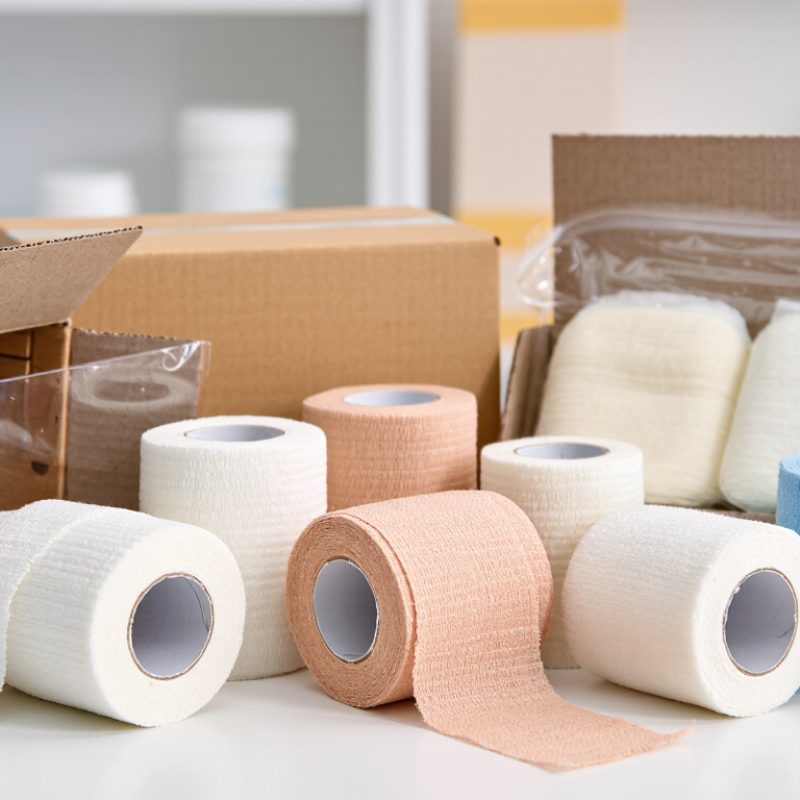
Self-adhesive bandages are designed to grip themselves, not the skin beneath them. Common formats include cohesive elastic rolls, lightweight nonwoven wraps, and pre-cut strips for small areas. Cotton and rayon can improve softness; polyester and elastane add strength and stretch. Some products contain natural rubber latex, so material details matter for users with sensitivities. The wrap should feel secure, not tight. A small practical detail: edges can loosen when wet or repeatedly rubbed.

Applications range from holding gauze in place to providing light compression during sports or recovery. Veterinary teams also use cohesive wraps because they can be applied without adhesive touching fur. The World Health Organization’s Road Traffic Injuries fact sheet reports 20–50 million non-fatal injuries worldwide each year. That figure underscores the need for accessible first-aid supplies, though a bandage is not a substitute for clinical assessment. Buyers comparing products should check width, stretch, breathability, tearability, and latex disclosure. A 5 cm roll may suit a wrist; a wider roll can cover a larger limb. Still, “more stretch” does not always mean better support. Fit and application technique matter.

How Manufacturers Control Stretch, Cohesion, Width, and Roll Length

For global buyers, a self-adhesive bandage should stretch predictably without feeling loose or restrictive. Manufacturers check elongation and recovery by pulling samples under controlled conditions, then comparing results across production batches. A sample may behave differently after storage or in a cool room. That detail matters. Too much stretch can make application inconsistent, while too little may limit adjustment around a joint. Buyers should ask for the test method, not just a stretch percentage.

Cohesion is the bandage’s ability to cling to itself, rather than skin or hair. Production checks can include wrapping a strip around a test surface and observing whether layers stay together during movement. Width is measured at several points across a roll; uneven edges can affect overlap and coverage. Roll length also needs verification, since a stated length is only useful when the measuring method is clear. Ask for batch records and sample rolls. Small differences happen. Measurements do not always capture how a bandage feels in the hand, so practical application trials can reveal issues that a specification sheet misses.

Comparing Suppliers by ISO 13485:2016 Quality-System Certification

Top Self Adhesive Bandage Manufacturers for Global Buyers

For global buyers, ISO 13485:2016 certification is a useful starting point when comparing self-adhesive bandage manufacturers. It signals a quality-management system designed for medical devices, including documented controls, traceability, and corrective action. It does not prove that every bandage performs equally well. Buyers should check the certificate’s validity, issuing body, covered manufacturing site, and product scope.

The ISO Survey 2022 reported 36,848 ISO 13485 certificates across 119 countries and economies. That is a certificate count, not a count of factories or a ranking of suppliers. Ask for evidence that the audited site actually handles relevant steps, such as adhesive coating, slitting, die-cutting, and packaging. If sterilization is part of the product specification, verify how that process is controlled. Small scope details matter.

A practical review should include sample records, batch traceability, complaint handling, and change-control procedures. Ask how the supplier monitors adhesive consistency across production lots; a clean certificate cannot show the feel of a bandage on skin. One awkward detail deserves attention: paperwork may look immaculate while a coating roll varies. Request recent audit evidence where available, then compare it with samples and production records. Certification supports due diligence, but it should not replace it.

Top Self Adhesive Bandage Manufacturers for Global Buyers - Comparing Suppliers by ISO 13485:2016 Quality-System Certification

Buyer-side comparison framework. Supplier-specific certification status is not stated; verify each supplier and manufacturing site directly.

Comparison dimension What buyers should compare Evidence to request How to assess it
ISO 13485:2016 certification Whether the quality-management-system certificate is current and covers the relevant legal entity and manufacturing site. Certificate copy showing certificate number, issuing certification body, site address, scope, issue date, and expiry date. Confirm the certificate’s status with the issuing certification body. ISO 13485 certification applies to a quality-management system; it is not product approval.
Certificate scope and site coverage Whether the stated scope and covered location match the activities relevant to the bandages being purchased. Certificate scope, site list or annex, and confirmation of which site performs manufacturing, packaging, and any outsourced processes. Check the actual certificate wording rather than relying only on a general claim of being “ISO certified.”
Product configuration Bandage dimensions, backing material, adhesive type, absorbent pad, intended use, and available variants. Product specification, labeling, packaging details, and samples representative of the quoted product. Compare documented specifications against the purchasing requirements; do not assume products with similar names have identical materials or performance.
Sterile or non-sterile supply Whether the product is supplied sterile or non-sterile and whether that matches the intended market and use. Product labeling, sterilization method where applicable, and relevant process-validation and lot-release documentation. For products represented as sterile, verify the claim and supporting documentation. Applicable regulatory requirements vary by market and product.
Packaging and shelf life Unit packaging, packaging integrity, storage conditions, and the stated shelf life. Labeling, shelf-life rationale or validation summary, and packaging-validation information relevant to the product. Check that the expiry date and storage instructions are clear and that the supplied packaging is suitable for the product’s stated status.
Regulatory documentation Whether the supplier can provide documentation applicable to the intended destination market and product classification. Applicable declarations, registrations, or other market-specific documents, as relevant to the product and jurisdiction. ISO 13485:2016 certification alone does not establish that a product is authorized for sale in every market.
Traceability and post-market processes Lot identification, complaint handling, nonconformity control, and recall communication processes. Sample lot records, traceability procedure, and written complaint and recall procedures. Confirm that records can link supplied goods to production lots and that the supplier explains how quality issues are escalated.

Biocompatibility and Risk Checks Under ISO 10993-1 and ISO 14971

For a self-adhesive bandage, biocompatibility review should cover the finished product, not just its adhesive. The backing, absorbent pad, inks, and processing residues may also matter. Under ISO 10993-1, evaluation depends on the type and duration of body contact. A bandage used on intact skin presents a different exposure profile from one applied near damaged skin. Test selection should follow that assessment, rather than a fixed checklist.

ISO 14971 adds a practical way to identify and control risks across the product’s life cycle. Manufacturers can document hazards such as skin irritation, sensitization, adhesive residue, or loss of adhesion during wear. They should assess severity and likelihood, then record controls and remaining risks. Ask for the biological evaluation rationale, relevant test reports, and traceability to the exact materials supplied. Check whether material or process changes trigger a fresh review. Small changes can matter.

Paperwork helps, but it can create false comfort. A report may describe a different formulation or test sample. Buyers should confirm that evidence matches the production bandage and its intended use. A qualified review is still needed.

Global Buyer Checklist: Regulatory Compliance, Capacity, and Lead Times

Top Self Adhesive Bandage Manufacturers for Global Buyers

A reliable supplier should show more than a certificate. Check whether its quality system, product labeling, and technical file match your destination market and the bandage’s intended use. The WHO’s 2017 Global Atlas of Medical Devices compiled country-level information from 140 countries, underscoring how medical-device oversight varies across markets. Ask for current registration evidence and confirm it directly with the relevant authority.

For U.S.-bound products, FDA’s Quality Management System Regulation final rule aligns its quality-system requirements more closely with ISO 13485:2016; compliance is required from February 2, 2026. Request audit records, batch traceability, complaint handling procedures, and change-control details. Paperwork can look tidy. Verify the actual scope.

Capacity needs evidence, too. Ask for monthly output by size and material, current utilization, minimum order quantities, and recent on-time delivery figures. Request a sample production schedule, not just a best-case promise. Lead times should separate raw-material sourcing, production, inspection, and shipping. A supplier quoting four weeks may exclude a delayed adhesive shipment or a full production queue. Compare the quoted schedule with recent order records, and leave room for surprises.